Arkham, a company that analyzes blockchain data, has created a public map showing cryptocurrency wallets believed to be connected to Iran’s central bank. This makes information about Iran’s crypto assets openly available to researchers and the public.
How Iran Moves Money Through Crypto
The map highlights two digital wallets using the Tron network that the U.S. Treasury Department added to its list of sanctioned entities on April 24th. Treasury officials say these wallets belong to Iran’s central bank, Bank Markazi Jomhouri Islami Iran, and are connected to the Islamic Revolutionary Guard Corps-Qods Force and Hezbollah.
Treasury Secretary Scott Bessent announced that approximately $344 million in cryptocurrency has been frozen. This action aims to prevent Iran from obtaining and transferring money.
Tether, the company behind the stablecoin USDT, has frozen some funds following a request from US authorities. They stated the freeze is related to activity linked to illegal actions, though they didn’t specifically mention Iran in their announcement.
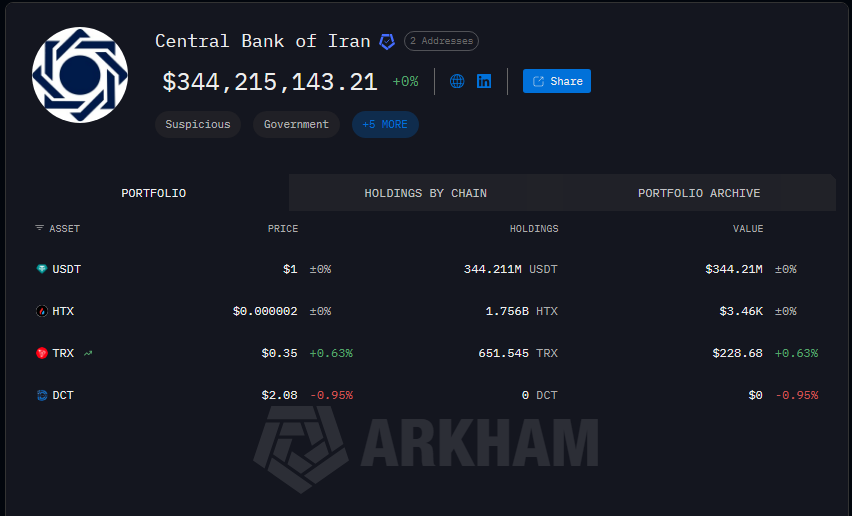
On May 11th, Arkham released a report identifying cryptocurrency addresses linked to Iranian sanctions. They’ve organized these addresses under a profile for a Central Bank of Iran entity, which researchers can use to investigate related wallets and how money moves between them.
As an analyst, I’ve determined the compromised wallets contained TRC-20 tokens. These tokens are built on the Tron network and notably include USDT, which is currently the biggest stablecoin by market value.
A Layered System Built To Hide
Tracing the money is complicated. Chainalysis reports that income from Iranian oil sales went through a series of steps – including brokers, temporary digital wallets, connections between different blockchains, and decentralized financial systems – before finally reaching accounts tied to Iran’s central bank and organizations linked to the IRGC. This process was deliberately designed to hide where the money came from, with each step making it harder to trace the funds back to their source.
According to a TRON representative, the TRON network isn’t able to directly watch or stop specific transactions. However, they highlighted the T3 Financial Crime Unit – a collaboration between TRON, Tether, and TRM Labs that began in 2024 – as the primary way they identify and address misuse.

According to a spokesperson, the team collaborates with police to block access to hundreds of millions of dollars linked to sanctioned organizations and those funding terrorism. Tether did not provide any additional comments.
Iran’s Crypto Activity Runs Deep
These compromised digital wallets are part of a much bigger trend. Data from TRM Labs and Chainalysis suggests that Iran processed around $11.4 billion in cryptocurrency transactions in 2024, and a similar amount – $10 billion – in 2025.
Reports suggest Iran is exploring the possibility of accepting cryptocurrency as payment for ships traveling through the Strait of Hormuz. This indicates they’re viewing digital currencies as a potential source of income, not just a way to bypass international sanctions.
Read More
- Gold Rate Forecast
- Brent Oil Forecast
- EUR AUD PREDICTION
- Gold’s Mad Dash to $5,000: Will It Outrun Its Own Shadow?
- DOGE EUR PREDICTION. DOGE cryptocurrency
- PEPE PREDICTION. PEPE cryptocurrency
- EUR CNY PREDICTION
- GBP CAD PREDICTION
- IP/USD
- SUI’s $1.04 Flirtation Ends in $1.02 Regret
2026-05-14 01:28