Bitcoin is clinging to the chair at the bar above $80,000, while the market tries on its resistance like a new hat and debates whether this March-to-now recovery is the real thing or just a very convincing selfie. The price has bounced 17.5% in the last month-a pretty dramatic glimmer that has nudged sentiment from “oh dear” to “perhaps we can stay here a moment longer.” And then, because life loves a plot twist, Carmelo Aleman publishes a whale behavior study that looks beneath the gloss and finds a signal worth sipping before we declare the recovery a triumph.
The analysis tracks two distinct categories of large Bitcoin holders across the April 3 to May 2 period. The methodology separates entities holding more than 1,000 BTC into two camps based on the age of their holdings. New Whales are those whose Bitcoin is younger than 155 days – recent capital that tends to be more price-sensitive and tactically active. Old Whales hold Bitcoin older than 155 days – longer-term, more structurally committed capital that tends to move less reactively to short-term price changes.
The distinction matters because the two cohorts have behaved very differently during the same 17.5% rally. Understanding which type of capital drove the move, which type sat it out, and what that combination implies about the sustainability of the current price level is the analytical contribution Aleman’s study provides.
Bitcoin above $80,000 looks constructive on the chart. The whale data adds a more nuanced reading beneath it.
Two Types of Whales. Two Completely Different Responses to the Same Rally
Aleman’s data makes the divergence between the two cohorts impossible to dismiss. Over the same 30-day period and the same 17.5% price increase, new whales realized approximately $865 million in net profits while old whales ended the period with a negative net reading near $87 million. The profit-taking that occurred during the rally was driven entirely by recent capital, not by the participants who have held Bitcoin through multiple cycles.

The balance changes confirm the behavioral split with precision. New whales grew their holdings from 985,639 BTC to 1,135,400 BTC – adding approximately 149,800 BTC, a 15.2% increase in exposure during the rally. Old whales moved from 3,323,800 BTC to 3,325,000 BTC – a change of just 1,200 BTC, or 0.04%. For practical purposes, the most structurally committed Bitcoin holders did nothing during a 17% price recovery.
The reading Aleman draws from that data is specific. New whales are behaving like tactical traders – building exposure and taking profits actively, closer in behavior to spot market participants than to long-term holders. Old whales are in structural holding mode – no meaningful accumulation, no aggressive distribution, simply maintaining positions that have been held through far larger price swings than a 17% monthly recovery.
The crucial caveat Aleman adds reframes the entire analysis. These cohort metrics describe behavior, not direct market impact. They do not measure buy or sell pressure on the order book. The evidence from previous analyses, Aleman notes, points to the recent Bitcoin move being dominated primarily by futures positioning rather than by ETF inflows or direct whale accumulation. The whales were present. They were not the engine.
Bitcoin Tests $81K As Recovery Approaches Major Trend Resistance
Bitcoin is trading near $80,800 after extending its recovery from the February capitulation low, but the structure is now approaching a critical inflection point. The chart shows a clean sequence of higher lows since March, confirming a shift from downtrend to recovery. Price has reclaimed both the 50-day and 100-day moving averages, which are now acting as dynamic support around the $72,000-$74,000 region.
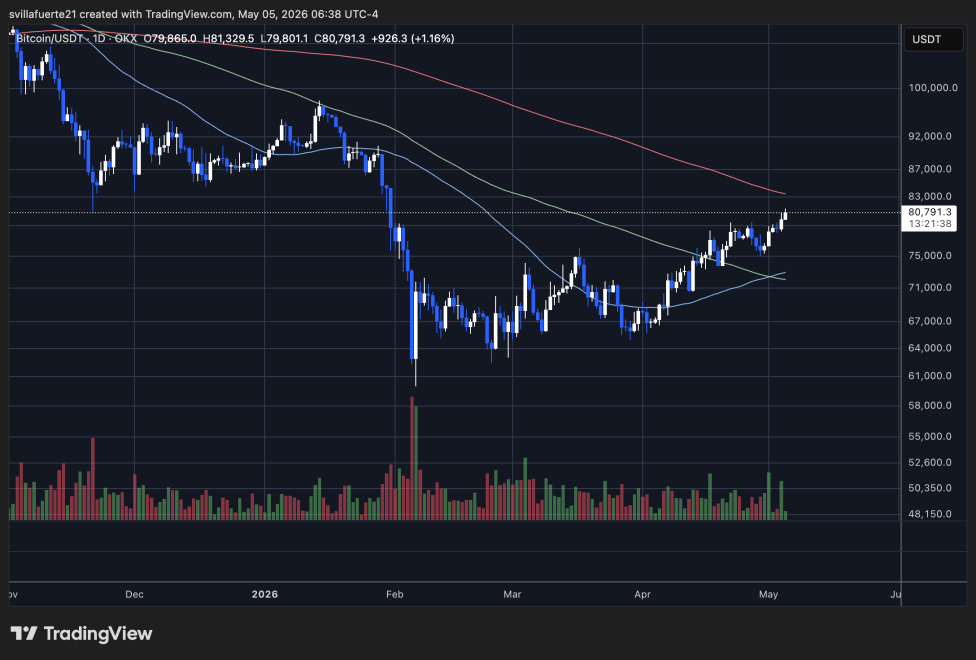
However, the key challenge sits directly overhead. The 200-day moving average continues to trend downward near the $82,000-$84,000 zone, creating a confluence of resistance that has historically defined trend direction. Bitcoin is now testing that level for the first time since the breakdown, making this a structurally important moment.
Volume does not fully confirm the strength of the move. While the recovery has been orderly, participation remains lower than during the selloff phase, suggesting the rally may be driven more by reduced selling pressure than aggressive new demand.
The immediate structure is constructive, but not yet decisive. A confirmed break above $82,000 would shift the market into a higher-high formation and open the path toward $90,000. Failure at this level would likely trigger a pullback toward the $74,000 support zone, where buyers have previously stepped in.
Read More
- ETC PREDICTION. ETC cryptocurrency
- Gold Rate Forecast
- Brent Oil Forecast
- EUR CNY PREDICTION
- ONDO PREDICTION. ONDO cryptocurrency
- XRP EUR PREDICTION. XRP cryptocurrency
- GBP CHF PREDICTION
- IP/USD
- You Won’t Believe What XRP Just Did: $75M ETF Inflows and Whale Drama Unveiled!
- USD VND PREDICTION
2026-05-06 07:56