XRP has been finding it difficult to stay above $1.35 as the market adjusts after the Federal Reserve’s recent actions, which have reduced trading activity, especially in derivatives, to the lowest levels seen this year. The price is now at a key point, and a report from CryptoQuant details how XRP’s market behaved immediately following the Federal Reserve’s decision on April 29th.
As expected, the Federal Reserve decided to keep interest rates steady, remaining between 3.50% and 3.75%. Jerome Powell also announced he will continue serving on the Federal Reserve Board after his term as chair ends, which kept investors focused on this news alongside the rate decision and affected trading across various markets. This combination of factors had an immediate and noticeable impact on XRP trading in the derivatives market.
On April 29th, the total value of XRP futures contracts held on Binance (known as open interest) dropped to around $208 million. This brought the amount of leverage used by traders back to where it was in February 2026. This decrease is important not just because of the number itself, but because it shows that all the leveraged positions built up between February and late April were closed out quickly, essentially returning the market to its initial state.

The market quickly bounced back. Now, the key question is whether the current price will continue to rise or fall.
The Leverage Is Gone. The Demand Has Not Arrived Yet
A recent CryptoQuant report shows that the decrease in crypto trading activity isn’t just due to traders reducing their borrowed funds (deleveraging). It also indicates a genuine drop in actual buying interest. Since April 17th, the estimated net buying volume on major crypto exchanges has fallen by around $920 million. The fact that both borrowing and buying have decreased at the same time suggests this isn’t a typical, positive market correction.

The perpetual market provides another signal confirming the trend. Binance Perpetual CVD decreased from around -$271 million to -$383 million, meaning selling pressure increased by another $112 million, even though fewer new contracts were being opened. Unlike what might be expected, sellers continued to be active during this period instead of pausing their activity alongside those closing out leveraged long positions.
Liquidation data helps explain market movements. From April 17th to the end of the month, most liquidations involved traders closing out long positions. This was especially true around April 29th, following news related to the Federal Reserve and Jerome Powell. These traders, who had previously invested heavily in long positions, were forced to sell, increasing the supply of assets in a market where demand was already decreasing.
The report’s main point is straightforward, but with a condition. While the XRP market is in better shape – with risky debt and unstable positions gone – it’s not yet ready for a big rebound. For the price to truly recover from its current level of $1.35, we need to see consistent buying pressure. Until that happens, the market correction seems finished, and the next price movement is still uncertain.
XRP Compression Tightens As Market Tests Post-Deleveraging Support
XRP is currently trading around $1.37, staying within a tight price range since the significant drop in February. While the overall trend isn’t clear, the price movement is becoming more constrained. After briefly falling to $1.15, the price has stabilized and is now showing a series of slightly higher lows, which suggests people are slowly buying XRP rather than a strong change in direction.
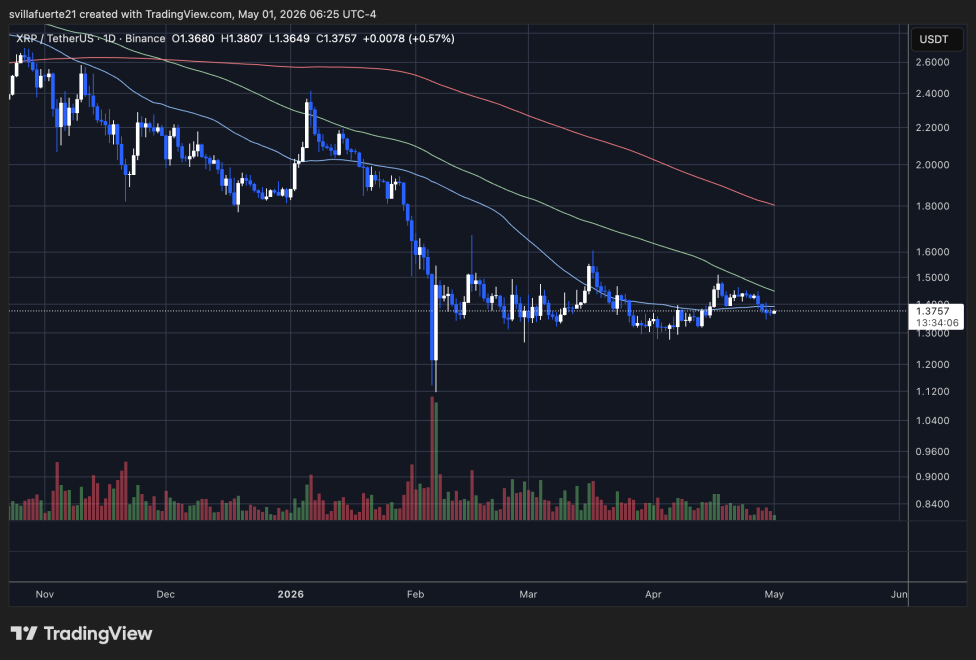
Despite some recent stability, the overall outlook for XRP remains negative. The price is still below key moving averages, with the 50-day average now acting as a ceiling. Longer-term averages (100-day and 200-day) are also falling, suggesting a continuing downward trend in the medium term.
The $1.35 price level is a crucial turning point. It has consistently functioned as both a floor preventing further price drops and a ceiling resisting price increases, indicating a balance between buyers and sellers. The recent failure to break above $1.45 confirms that there’s still selling pressure at higher prices, which is currently holding back any significant upward movement.
Looking at recent trading volume, I’m seeing signs that the market is settling into a consolidation phase. Volume is considerably down from the drop we saw in February, suggesting fewer traders are actively participating after the recent period of deleveraging. Historically, this kind of slowdown often comes before a new upward trend, but it doesn’t guarantee which way we’ll go next.
If the price clearly rises above $1.45, it could signal a significant upward trend, potentially reaching $1.60. However, if the price falls below $1.33–$1.35, it would negate the recent positive pattern and likely cause a drop back to around $1.25, a level where buyers previously stepped in.
Read More
- Silver Rate Forecast
- Polymarket’s 3.14% Pie: A Slice of Genius or Just Crumbs?
- ONDO PREDICTION. ONDO cryptocurrency
- Brent Oil Forecast
- Coinbase’s OCC Nod: Not a Bank, Just A Trust-Big Moves Ahead!
- Claude’s ID Fiasco: Anthropic’s Latest Farce in AI Theatre
- XRP’s Institutional Comeuppance: Finally, a Seat at the Table
- Gold Rate Forecast
- Bitcoin at 75k: The Trigger That Could Unleash a Rally
- Crypto’s Last Gasp: Lummis Pleads, ‘Act Now or Regret Eternally’
2026-05-02 04:58