So, here’s a little story about Ripple’s CTO, David “JoelKatz” Schwartz, who decided to clear up a few things on July 30. You know, the kind of day where you just want to explain why, despite having more bank deals than you can shake a stick at, the XRP Ledger (XRPL) is still a bit of a ghost town. 🏚️
It all started with a curious investor and YouTuber named Andrei Jikh, who had the audacity to ask some tough questions. Like, why, after more than a decade and “300+ bank partnerships,” isn’t the XRPL clearing “billions in daily on-chain volume”? And why would anyone in their right mind choose a volatile asset like XRP over stablecoins? 🤔
Schwartz’s answers were as delightful as they were enlightening. For starters, he pointed out that even Ripple can’t use the XRPL DEX for payments yet because, well, you never know when a terrorist might be the one providing the liquidity. “Features like permissioned domains will address this,” he reassured us, though it’s hard not to imagine the DEX as a wild west of financial transactions. 🤠
When pressed on whether the same counterparty-risk problem exists on other Layer 1s, Schwartz was refreshingly honest: “Generally decentralized exchanges on public layer 1’s don’t give you any control or knowledge of who your counterparties are.” He added, with a shrug, “Regulations aren’t always totally logical.” 🤷♂️
But the real kicker came when he talked about “permissioned domains.” These domains are designed to keep the ledger’s openness while ensuring that everyone playing the game follows the rules. “Retail is welcome in the permissioned parts provided they can prove they’re not sanctioned,” he explained, as if to say, “As long as you’re not on the naughty list, you’re good to go!” 🎅
XRP Vs. Stablecoins
On the topic of stablecoins, Schwartz was quick to defend XRP’s honor. “Volatility isn’t always a minus, or is even a plus,” he argued, suggesting that sometimes it’s better to be a bit unpredictable. He also pointed out that a bridge currency needs someone to hold it, so it’s ready when you need it. “If users don’t know which asset they will need next, they may rationally hold the ‘dominant bridge’ because it’s cheaper to pivot from a liquid hub asset into whatever comes next.” 🌉
He even tackled the question of whether bridge assets still matter in a world dominated by stablecoins. “If one stablecoin wins, it could act as the bridge, but I don’t think a single stablecoin can win because each is only stable relative to one particular fiat currency.” In other words, the world is a big place, and different regions have different needs. 🌍
“Ask the same question about Circle—why don’t they launch USDC only on their own blockchain?” The answer, of course, is that ubiquity and liquidity come from being everywhere at once. 🌐
On the geopolitical front, Schwartz made it clear that the XRPL is neutral infrastructure. “It’s not really US-based,” he wrote, adding that the ledger “has never discriminated against any particular participant.” However, he did admit that Ripple’s own products are subject to licensing realities, meaning some places—like North Korea or Cuba—are off-limits. 🚫
Finally, Schwartz noted that XRP’s role within Ripple’s payments stack remains significant, even if much of it isn’t visible on public ledgers. “XRP’s use as a bridge in Ripple Payments dwarfs every other asset,” he claimed, reminding us that “XRP has a privileged place on the XRP Ledger.” 🌟
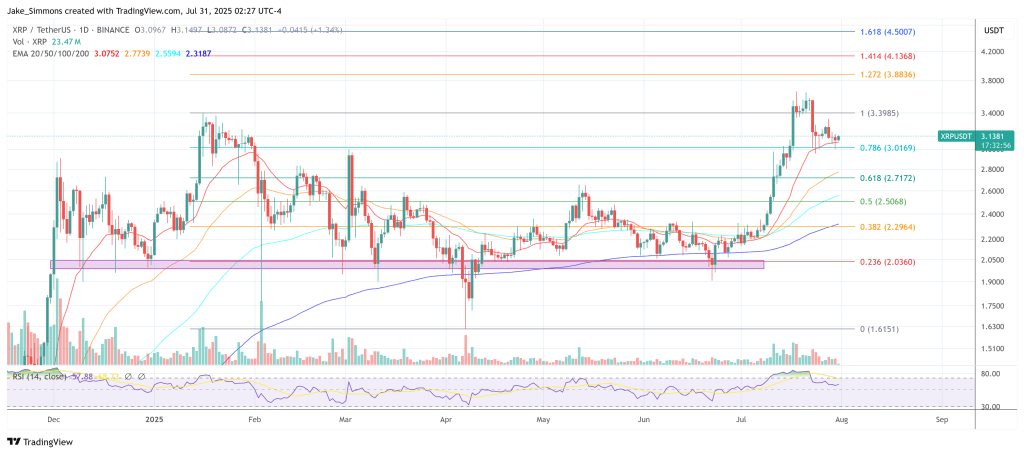
At the time of writing, XRP was trading at $3.13. Not bad for a crypto that’s trying to bridge the gap between the wild west and the regulated world. 🛸
Read More
- USD HUF PREDICTION
- Gold Rate Forecast
- Crypto Boom: Figure and Friends Leap into the Market-Is it Genius or Madness? 🤔💸
- One Weird Trick: Billionaires Flock to Crypto-Ready Trump Tower in Dubai! 🏦🏙️
- Brent Oil Forecast
- How Ethereum Became the Unexpected Hero of AI Finance 🚀💰
- Frog Frenzy: You Won’t Believe What PEPE Just Did! 🚀
- Silver Rate Forecast
- You Won’t Believe How $3B in Real Estate Is Now Just Tokens. Mind-Blowing, Right?
- Will BNB’s $600 Wall Finally Crumble? Spoiler: The Hodlers Are Plotting 😉
2025-07-31 20:14