In the grand theater of American politics, Senator Chuck Schumer, that paragon of political wisdom, now speaks of a “good crypto bill” as if it were a holy scripture, hinting at a possible alliance between the warring factions of the Senate as they strive to complete two monumental laws on digital assets by the year 2026. One might wonder if the very idea of bipartisanship has finally found its way into the chambers of Washington, D.C., where even the most ardent opponents of crypto legislation now whisper of compromise.
-
Key Takeaways:
- Schumer publicly backed crypto legislation, saying Democrats want “a good crypto bill” to pass in 2026. A noble goal, though one might question whether “good” here refers to the bill’s content or the ease with which it can be passed without furthering the cause of clarity.
- The GENIUS Act, passed with a resounding 68-30, saw 18 Democrats cross the aisle, a feat that would make even the most ardent optimist question the state of political loyalty.
- Senate Banking Chair Tim Scott has targeted a CLARITY Act markup for May 14 and a floor vote by June or July. One can only hope the Senate’s calendar is as reliable as its members’ promises.
FROM OPPOSITION TO OPENNESS
Schumer’s comment came during what has been a turbulent stretch for U.S. crypto legislation. Earlier in the debate over the GENIUS Act, Schumer had told Democratic members not to commit to voting for the bill until changes were made. Despite that pressure, the Senate voted 68-30 to pass the GENIUS Act, with 18 Democrats crossing the aisle. The bill was signed into law in July 2025. One might say that even the most stubborn of leaders can be swayed by the allure of political expediency.
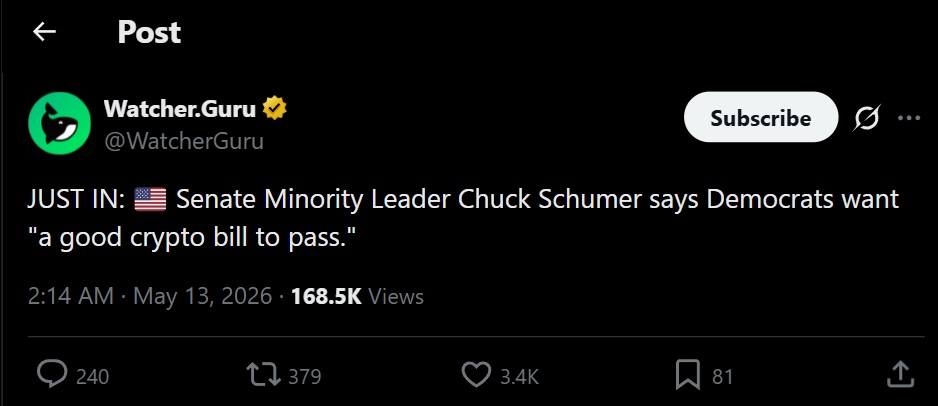
Now attention has shifted to the next major bill, i.e., the Digital Asset Market Clarity (CLARITY) Act, which covers the broader market structure for crypto assets beyond stablecoins. Schumer’s choice words in “good crypto bill” may carry a pointed qualifier given that the Democratic party’s resistance to the CLARITY Act has increasingly centered on an ethics provision that would bar senior government officials, including the president, from profiting off crypto markets while regulating the industry. One might wonder if the true battle is not over the bill itself, but over the very notion of ethical governance in a world where even the most basic principles of fairness seem to be up for negotiation.
That provision was removed from the May 2026 draft of the bill, drawing swift pushback from Democratic senators who say the bill is “dead on arrival” without it. Senator Kirsten Gillibrand, one of the GENIUS Act’s original architects, has stated CLARITY cannot advance without such a safeguard. A curious paradox: the same senators who once resisted the GENIUS Act now demand its moral equivalent in the CLARITY Act, as if the very idea of integrity were a commodity to be traded.
This tension reflects a broader dynamic, given that the crypto industry has backed the yield compromise in the bill, which bans yield on stablecoins equivalent to bank deposits but allows “bona fide activities.” Even then, the ethics question remains unresolved. Coinbase and Circle both urged the Senate Banking Committee to advance CLARITY after the yield deal was struck. One might conclude that the industry’s true allegiance lies not with regulation, but with the promise of profit, no matter the cost.
WHY IT MATTERS
The CLARITY Act would establish a comprehensive regulatory framework for the broader crypto market, addressing which tokens qualify as securities versus commodities and which regulators, the SEC or the CFTC, have jurisdiction. For exchanges, projects, and institutional players operating in the U.S., the law would be transformational. Yet one cannot help but wonder if the true transformation lies not in the law itself, but in the willingness of lawmakers to embrace a system that, for all its complexity, remains as enigmatic as the men who seek to govern it.
Schumer’s signal, however cautious, suggests that Democrats are not looking to block crypto legislation outright but want specific guardrails. If the ethics provision finds its way back into the draft, a bipartisan path to passage before the end of 2026 begins to look more plausible. For an industry that has spent years navigating regulatory hostility, even that level of political openness is worth watching closely-though one might question whether the real beneficiaries are the lawmakers themselves, who now find themselves in the curious position of advocating for a system they once scorned.
Read More
- Gold Rate Forecast
- Silver Rate Forecast
- Brent Oil Forecast
- GBP CAD PREDICTION
- EUR KRW PREDICTION
- EUR AUD PREDICTION
- USD IDR PREDICTION
- EUR CNY PREDICTION
- PEPE PREDICTION. PEPE cryptocurrency
- IP/USD
2026-05-13 12:32