Key Highlights
- Robinhood shares rose more than 8% intraday, reaching around $91.92 on May 29.
- The rally followed Robinhood’s rollout of AI-agent trading and AI-enabled card spending.
- The move suggests HOOD is finding a new investor narrative beyond Bitcoin and crypto trading volumes.
Robinhood’s stock price increased significantly on May 29th after the company launched its new AI assistant. This gave investors a new reason to buy the stock, separate from the usual factors like Bitcoin prices or overall trends in the cryptocurrency market.
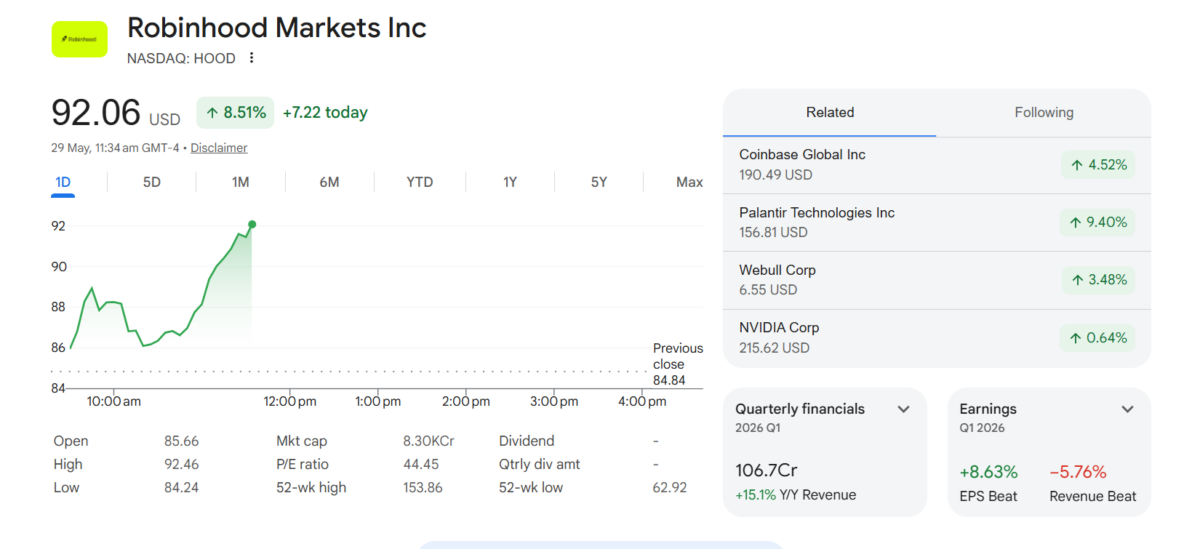
According to Google Finance, HOOD stock was trading at approximately $91.92, an increase of 8.35% for the day. It started the day at $85.66, reached a high of $92.46, and closed significantly higher than the previous day’s closing price of $84.84.
Robinhood’s stock price jumped, bringing the company’s total value to around $83 billion. While the stock is currently trading at 44.45 times its earnings, it’s still below its highest price of the year ($153.86), though it has significantly rebounded from a low of $62.92.
Looking at Robinhood’s recent quarterly results, I see a mixed picture. Revenue came in around $1.07 billion, which is a 15.1% increase year-over-year. While earnings per share beat expectations by 8.63%, revenue fell slightly short at 5.76%. This makes their new AI-agent rollout particularly important. It seems the market isn’t just valuing Robinhood based on current crypto trading or transaction revenue; investors are really looking ahead to future product growth and innovation, and the AI agent is a key part of that narrative.
This increase happened alongside gains for other companies in the financial technology, brokerage, and artificial intelligence sectors. For example, Coinbase Global increased by 4.52%, Webull rose 3.48%, Palantir jumped 9.40%, and Nvidia edged up 0.64%. This suggests Robinhood’s growth is part of a larger trend of investors favoring stocks in AI and trading platforms.
The recent surge in interest follows Robinhood’s announcement that users can now link AI programs to their accounts for trading and managing money. According to Robinhood’s help pages, users can set up a special ‘Agentic’ account and connect an AI program through Robinhood’s system. This allows the AI to access the account and make trades, but only within that specific, separate account.
AI Agents Give Robinhood a New Stock Catalyst
Right now, Robinhood’s AI trading tool only works for buying stocks, though the company plans to expand it to other investments in the future. This means the first wave of interest is focused on automating stock trades, rather than cryptocurrency.
Robinhood says its AI tools can assist users with managing their investments – things like creating investment portfolios, automatically executing trading plans, adjusting how money is distributed, and assessing potential risks. However, Robinhood emphasizes that users are still accountable for any trades made by these AI tools, and users can choose to let the AI trade automatically without needing to confirm each one.
This is important for Robinhood because its stock price has historically moved with Bitcoin. However, the recent increase suggests investors are now also recognizing Robinhood’s potential as a company focused on AI in finance. They see possibilities in features like automated investing, spending management tools, brokerage services, and the use of financial data within a broader range of products.
Robinhood Expands AI Into Card Spending
Robinhood is now applying its AI-powered approach to spending as well. With its new Agentic Credit Card, Gold Card members can create special virtual cards for their AI assistants. They can control how much these AI agents spend, require authorization for purchases, and even cut off access completely.
Robinhood now lets customers create a virtual Gold Card for their assistants or family members. They can control how much the card can be used, and even require approval for each purchase. Assistants can use the card to shop online based on the customer’s directions, and the customer can cancel the card whenever they want.
As a crypto investor, I’m seeing that Robinhood is building something bigger than just an AI trading tool. They’re aiming to be a full financial platform – covering investing, spending, banking, and even automating things. What’s interesting is they’re planning AI that *acts* on your behalf, within the boundaries you set, instead of just giving you advice like a typical chatbot. It’s about letting the AI execute, not just suggest.
Why This Is Not Just a Bitcoin Trade
Robinhood is introducing AI-powered tools that will let customers automatically trade stocks and make purchases using their Robinhood credit card. Users will also be able to set up a separate trading account, distinct from their main Robinhood account, to use with these AI agents, according to Reuters.
This distinction is key to understanding the risks involved with the product. Robinhood states that automated trading can make trades without your approval for each one, and you could lose all of your money.
Investors aren’t hoping Robinhood has eliminated risk altogether. Instead, they believe Robinhood could be ahead of the curve in creating a new way for people to manage their finances. This future involves more than just using an app – it envisions users assigning tasks to AI assistants that follow pre-defined instructions.
HOOD Rally Signals a Shift in Investor Narrative
Robinhood’s stock price has recently increased significantly, suggesting the market may be starting to view the company differently. In the past, gains in Robinhood’s stock were typically connected to the performance of Bitcoin, activity in cryptocurrency trading, or general investor enthusiasm. However, this latest rise seems to be driven by Robinhood’s new offerings in AI-powered trading and payment services.
While Bitcoin isn’t unimportant to Robinhood, its impact on the company’s revenue comes mainly from trading volume. More significantly, the introduction of AI-powered agents gives investors a new reason to evaluate Robinhood – not just as a brokerage, but as a foundational technology for the future of automated finance.
The potential downsides are also obvious. AI-powered trading could attract attention from regulators, lead to disagreements over financial losses, and raise concerns about whether it’s appropriate for all investors. This is particularly true if individual investors let the AI trade without their direct oversight. Robinhood seems to understand these risks and is highlighting features like separate accounts, spending controls, approval processes, fraud protection, and the option to turn off the AI trading tools.
As a researcher, I’m observing that investors are currently responding to the recent developments as a sign of potential growth for HOOD. The significant stock increase on May 29th demonstrates that positive narratives around AI and fintech can drive the stock’s performance, even independent of Bitcoin’s movements.
Read More
- Gold Rate Forecast
- USD TRY PREDICTION
- EUR CNY PREDICTION
- Silver Rate Forecast
- USD MXN PREDICTION
- Brent Oil Forecast
- EUR HUF PREDICTION
- RUNE Crashes Hard but Folks Keep Throwing Cash at THORChain—Why tho? 🤔
- PI PREDICTION. PI cryptocurrency
- JPY KRW PREDICTION
2026-05-29 19:17