The traders building their own AI tools right now are not engineers. They are people who decided to try. If you have been watching others ship custom bots, automate their workflows, and talk about vibe coding while you scroll past, this is where that changes.
Vibe coding collapses the gap between an idea and a working tool. You describe what you want to an AI, it writes the code, and you deploy it, no syntax, no tutorials, no paid courses. The only thing standing between you and your first working bot is 30 minutes. Unless you’re one of those people who insists on reading the manual instead of just pressing buttons, in which case… good luck.
Let’s start with something simple, yet useful. A crypto price alert bot that actually earns its place in your workflow. It watches 500 tokens around the clock and pings your Telegram the moment anything moves 10% or more in one hour. But the bot itself is not the point. The workflow you learn to build it is. Every tool you want after this – whale trackers, funding rate alerts, sentiment scanners- follows the exact same pattern. This is your first build. Everything else comes after. Unless you get distracted by cat memes, in which case… well, we’ve all been there.
What You Need Before Starting
The setup requires four things:
- A Mac or Windows computer that can stay on. (Unless you enjoy watching your bot die mid-trade, in which case, go ahead.)
- A Telegram account on your phone. (If you don’t have one, you’re living in the Stone Age.)
- Python installed on your machine, and
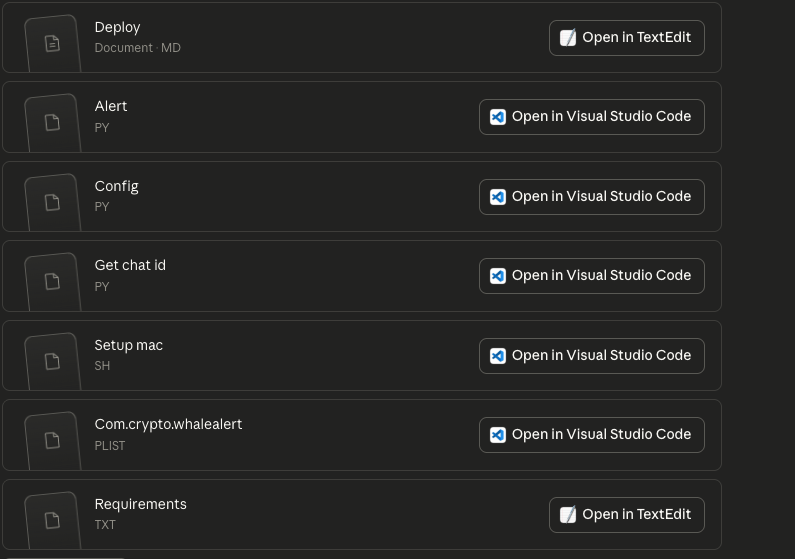
deploy.md, a plain-English guide walking you through the setupalert.py, the main script that fetches prices and triggers notifications;config.py, where your Telegram credentials and alert settings are stored;get_chat_id.py, a helper script to retrieve your Telegram chat ID;setup_mac.sh, a one-click script that installs everything and launches the bot;com.crypto.whalealert.plist, a background service file that ensures the bot auto-starts on login;requirements.txt, which lists the Python libraries the bot depends on;
you do not need to learn it. It’s like a Discworld creature-mysterious, ancient, and mostly harmless if you don’t poke it with sticks.
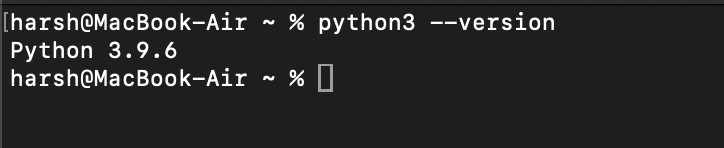
Open Terminal on Mac or Command Prompt on Windows, type python3 version (Mac) or python version (Windows), and press Enter. If a version number appears, you are ready. If not, ask your AI chatbot how to install Python on your operating system and follow its instructions. (This is where you learn that “AI” stands for “Ask Instructions.”)
Step 1 – Create Your Telegram Bot
Open Telegram and search for @BotFather, Telegram’s official bot creation tool. Send it /newbot. BotFather will ask you two things – a display name (e.g. Crypto Whale Alert) and a username (e.g. my_crypto_alert_bot – must end with the word bot). After that, BotFather replies with a long code that looks something like 7123456789:AAHxyz-abc123def456. This is your bot token. Copy it somewhere, a note on your phone, a message to yourself, whatever. You’ll need it soon. (Pro tip: Don’t paste it into a random website. We’re not that desperate.)
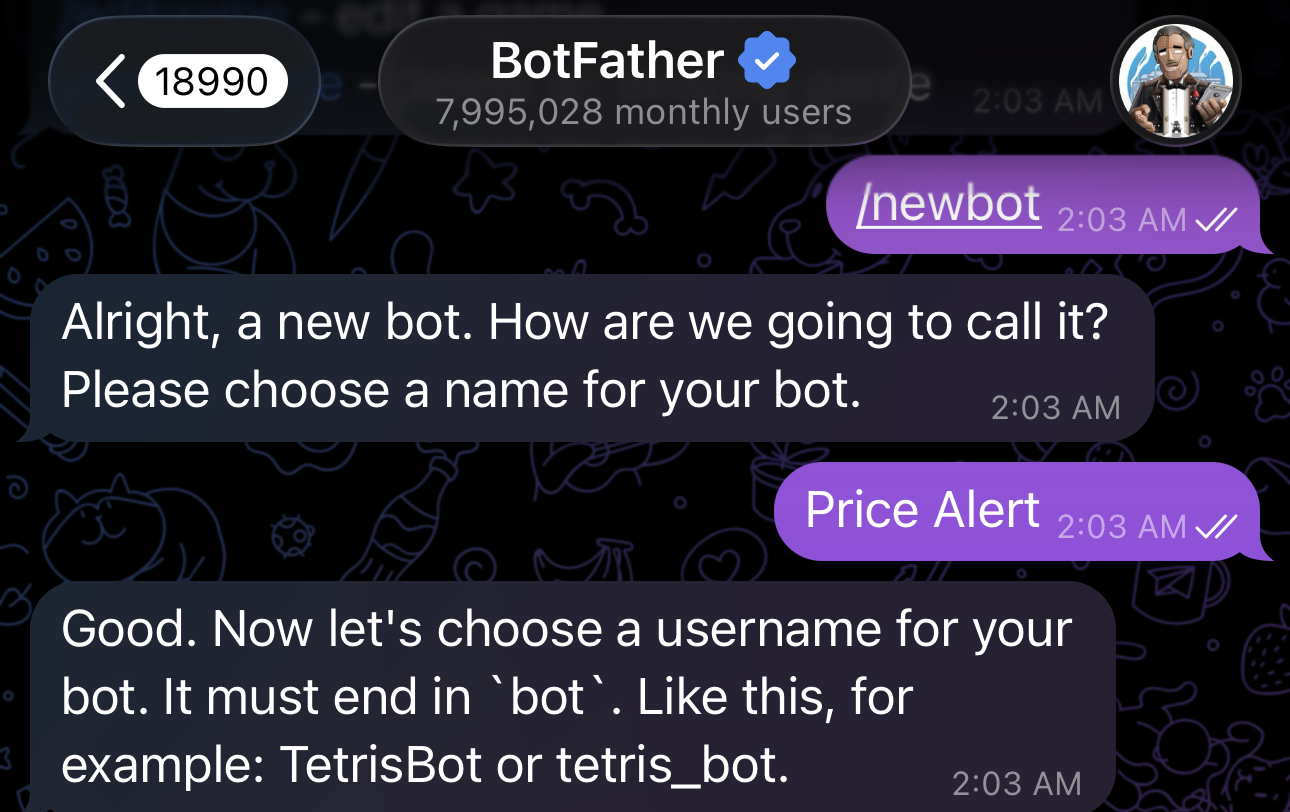
Open your new bot’s chat and send it any message. Telegram bots cannot message you first, so this step is required before alerts can reach you. (It’s like dating in the Discworld: you have to make the first move.)
Step 2 – Prompt Your AI To Build the Crypto Bot
Open your AI chatbot and describe exactly what you want. Here is a prompt that works:
“Build me a crypto price alert system. It should monitor the top 500 tokens by market cap, trigger a Telegram notification if any token moves 10% or more within one hour, enforce a two-hour cooldown per token to prevent spam, and run automatically on my computer for free.”
After writing the entire code for you, the AI generally returns a complete set of files. These include:
If something does not work, paste the error message back into the AI chat. It will tell you exactly what to fix. That back-and-forth is the entire debugging workflow. (Welcome to the Discworld of software development: magic, confusion, and the occasional explosion of logic.)
Step 3 – Configure Your Credentials
Create a folder called crypto-alerts on your computer and place all the AI-generated files inside it. Open the configuration file (config.py) in any text editor. Find two fields: one for your Telegram bot token and one for your Telegram chat ID. Paste your BotFather token into the first field.
TELEGRAM_BOT_TOKEN = "YOUR_BOT_TOKEN"
TELEGRAM_CHAT_ID = "YOUR_CHAT_ID"
To get your chat ID, open Telegram and search for @userinfobot. Start a chat with it. It instantly replies with your account details, including your chat ID. Copy that number, paste it into the second field in your configuration file, and save. (Your chat ID is like your digital fingerprint. Treat it with the respect it deserves-unless you’re a criminal, in which case… good luck.)
Step 4 – Launch the Bot
On Mac, open Terminal and run these two lines. Hit enter after each.
chmod +x ~/crypto-alerts/setup_mac.sh
~/crypto-alerts/setup_mac.sh
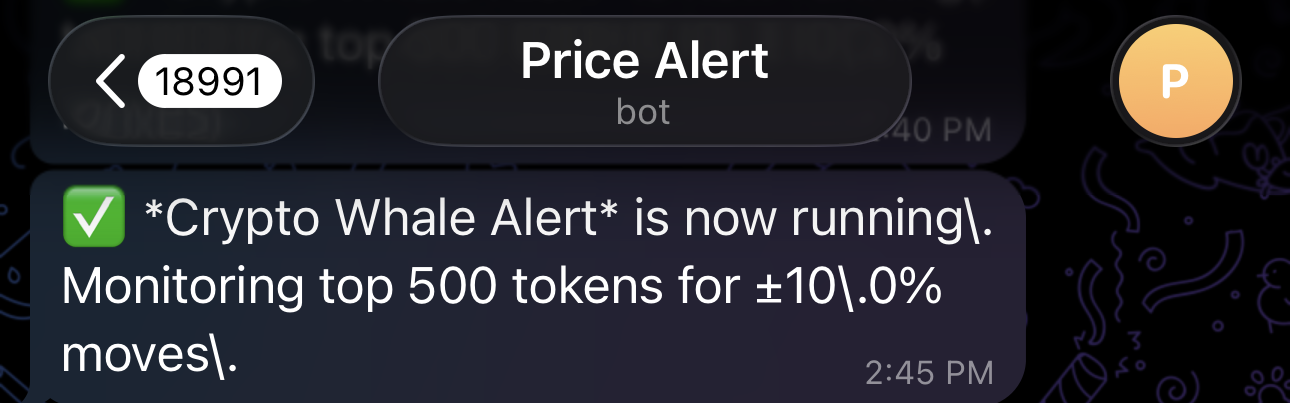
The first line gives your Mac permission to run the script. The second line runs it. You’ll see it checking Python, installing what’s needed, and starting the service. If it worked, you’ll get a Telegram message saying “Crypto Whale Alert is now running.” That’s the moment. That hit of dopamine when something you built actually works. Screenshot it. You’ve earned it. (Unless you’re a Luddite, in which case, you probably didn’t.)
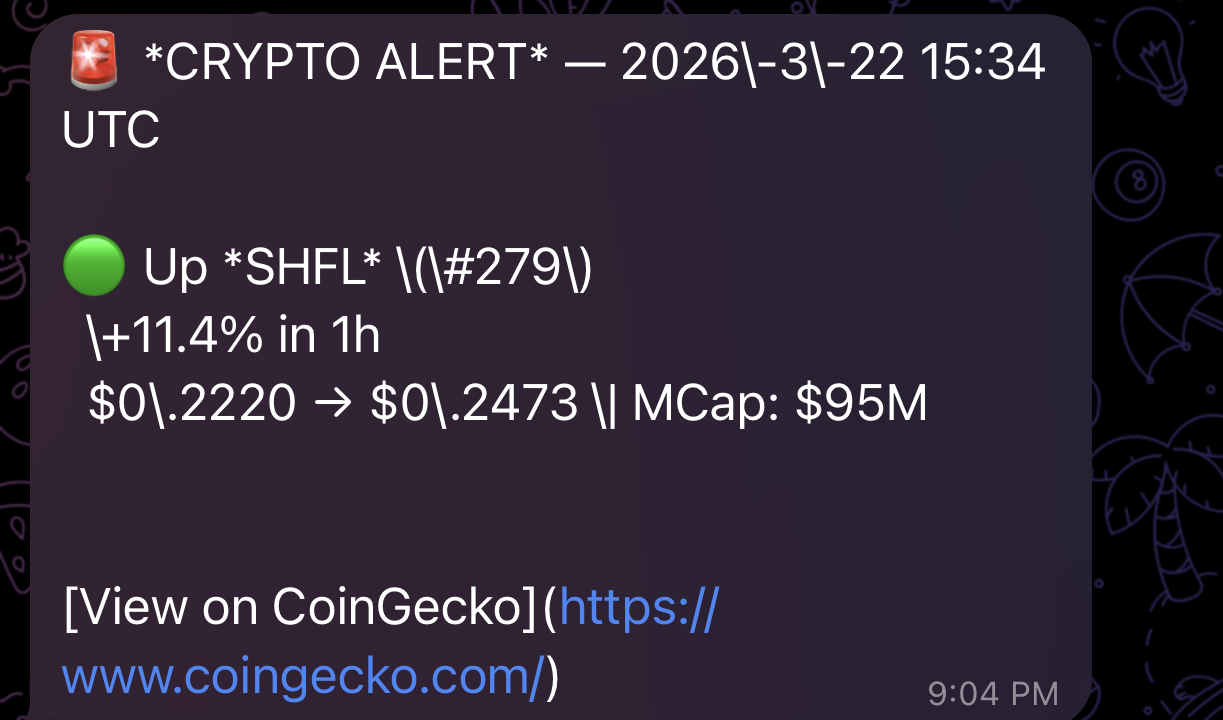
From that point, the bot checks prices every five minutes using CoinGecko’s free public API. After one hour of baseline data collection, comparisons begin. An alert arrives on your phone within minutes of any qualifying move, showing the token name, rank, direction, percentage change, price range, and market cap. If your computer sleeps, alerts pause. On Mac, go to System Settings, then Battery, and disable automatic sleep. On Windows, go to Settings, then System, then Power, and set sleep to “Never” while plugged in. Desktop machines on both platforms do not sleep by default. (Unless you’ve got a grumpy laptop with a vendetta.)
However, for traders who want alerts running around the clock without depending on their personal device, a Virtual Private Server (VPS) is the cleaner solution. A basic VPS plan costs roughly $5 a month, about the price of a coffee, and keeps the bot running 24/7 regardless of whether your computer is on or off. (Because nothing says “I care about my crypto” like paying for a server to do the work you’re too lazy to do.)
What To Build Next
The price alert bot is a foundation, not a ceiling. The same vibe coding workflow scales to more powerful trading tools with a different prompt fed into the same AI. For instance, a whale wallet tracker monitors specific on-chain addresses for large movements. A funding rate monitor flags when perpetual futures markets show overheating. A social sentiment scanner tracks token mentions across platforms and surfaces volume spikes before price reacts. Each follows the identical pattern: describe the problem, receive code, deploy in one session. (Welcome to the Discworld of finance: where imagination is the only limit… and even that’s negotiable.)
We’re shifting from the age of execution to the age of imagination.
People who’ve been in crypto long enough tend to be visionaries.
If you’re a crypto early adopter, I’d strongly recommend giving vibe coding a shot, even with zero coding experience.
But scammers and bad actors often target the crypto industry. An app purely built through vibe coding is likely to contain security vulnerabilities. However, for a personal alert bot running locally with no sensitive financial credentials stored, the exposure is low. For anything connecting to exchange API keys or wallets, run a follow-up prompt asking the AI to audit the code for security issues before deploying. (Because nothing says “trust” like asking a chatbot to check its own work.)
Vibe coding is not a technical skill. It is a habit. This bot is how you start building it. The traders who will have the most useful custom tools six months from now are the ones who built their first one today. (Unless they’re currently distracted by a particularly compelling meme. In which case… well, we’ve all been there.)
Read More
- ETH PREDICTION. ETH cryptocurrency
- Gold Rate Forecast
- Silver Rate Forecast
- Brent Oil Forecast
- USD THB PREDICTION
- Bitcoin Beats Silicon Valley: The Unlikely Hero of 2023 🚀
- Whales Gone Wild: Bitcoin’s Dramatic Buying Spree! 🐋💰
- Saylor’s Shocking Take on Bitcoin Proof of Reserves Will Leave You Speechless!
- Solana’s Swan Dive: Institutions Bet Big on a Sinking Ship?
- Strive Buys Bitcoin, Avoids Collapse (Just Barely)
2026-03-22 19:33