Key Takeaways
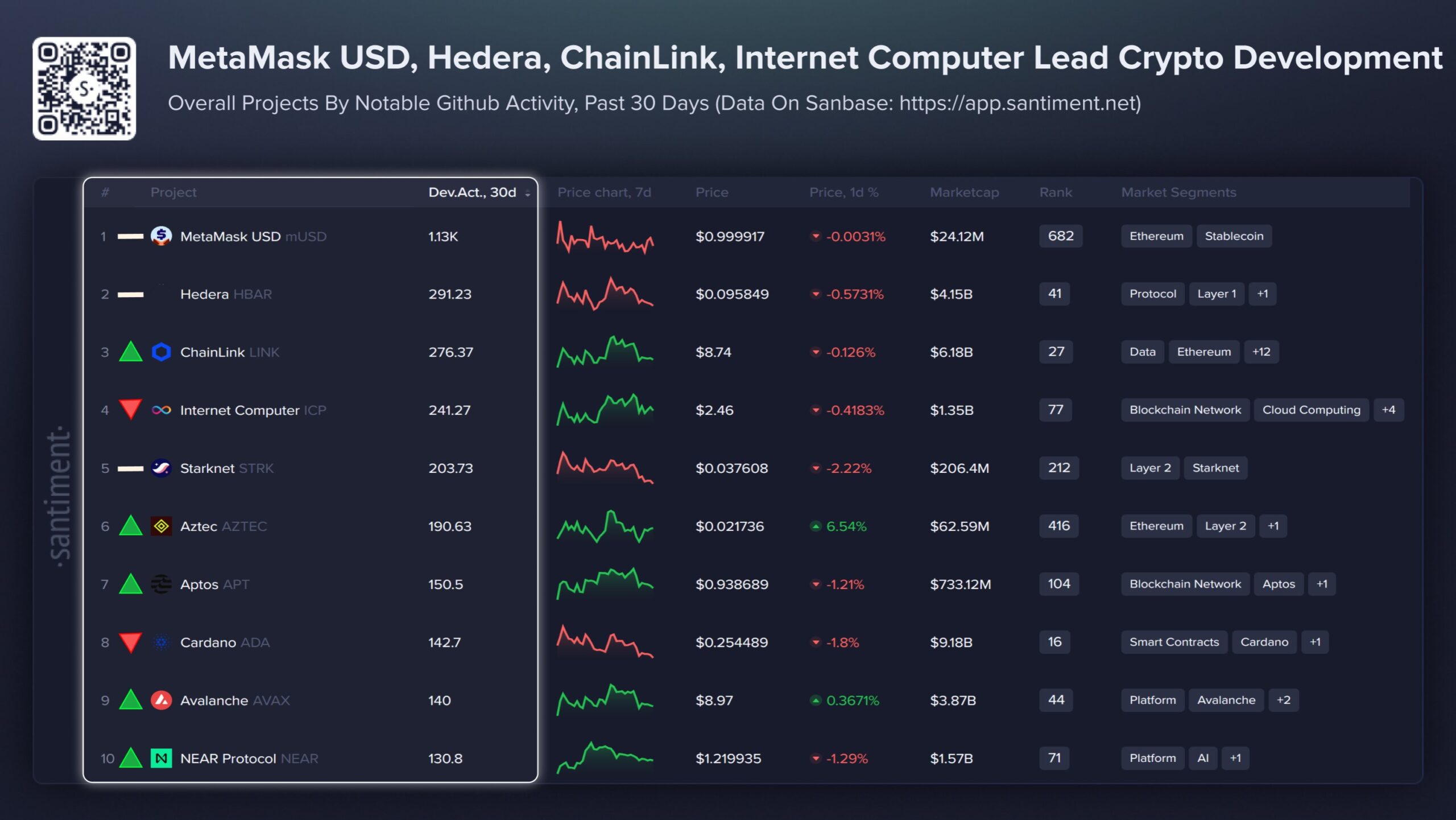
- MetaMask’s new stablecoin ($mUSD) is dominating crypto development activity by a wide margin in March 2026
- Chainlink, Hedera, and ICP round out a top 4 that spans stablecoins, enterprise blockchain, and decentralized cloud
- AI-crypto convergence is the loudest narrative right now, with NEAR, ICP, and Aptos all repositioning around it
- Despite heavy builder activity, market sentiment sits in “Fear” territory — retail hasn’t caught up yet
Tracking development activity is a trustworthy way to assess crypto projects. Unlike price, which can be easily manipulated, consistent coding updates and infrastructure improvements show a team is actively building. Conversely, a project that stops updating code after a price increase is often a red flag. As of March 2026, MetaMask USD (mUSD) leads the pack in development activity by a considerable margin.
Consensys released a new stablecoin in late 2025 that’s directly linked to U.S. Treasury bills and stored securely in user-controlled wallets. They’re now working to integrate it with Mastercard through the new MetaMask Card. The development work shows this is a serious project, not just a fleeting trend. The recent GENIUS Act, which provides clearer legal rules for stablecoins, has allowed projects like this to grow confidently, and Consensys is definitely taking advantage of that.
Hedera and Chainlink Hold Their Ground
Hedera (HBAR) is now the second most popular choice. It’s gaining traction with larger companies because it’s building tools for real-world assets, and a recent partnership with Stripe, through MINGO, shows a practical way it can be used.
Chainlink (LINK) remains the third-ranked project, which isn’t unexpected. Development of Cross-Chain Interoperability Protocol (CCIP) and high-speed Data Streams is progressing consistently. Chainlink’s strong position is now firmly established and it continues to benefit as more blockchains become popular.
The Middle of the List Is Where It Gets Interesting
Internet Computer (ICP) is currently ranked fourth and is making big changes to its tokenomics. A project called Mission 70 is designed to reduce inflation by 70% before the year ends. Recently, ICP also partnered with Pakistan to host the country’s national AI data directly on its network – a bold move that some see as forward-thinking, while others consider it overly ambitious.
As a researcher tracking Layer-2 scaling solutions, I’ve been following Starknet (STRK) closely. It currently ranks fifth in terms of activity, and the team is actively working on reducing transaction fees with their recent v0.13.1 upgrade. While the Layer-2 landscape is getting quite competitive and token performance hasn’t been stellar, I’m encouraged by the consistent development progress they’re demonstrating.
Aztec Network ($AZTEC) has climbed to sixth place after launching its token in February. Trading activity increased significantly when it became available on several exchanges in South Korea. Despite recent fluctuations in its price, more and more developers are becoming interested in learning Noir, Aztec’s programming language for privacy-focused applications.
Bottom Half: Aptos, Cardano, Avalanche, NEAR
Aptos (APT) became more deflationary on March 2nd when it reached its limit of 2.1 billion tokens. The network also demonstrated strong, actual usage by processing over 500 million transactions during a single gaming event, proving it can handle real-world activity.
Cardano (ADA) is in the process of a major system upgrade called Protocol 11. Simultaneously, customers can now use ADA to pay at 137 SPAR grocery stores across Switzerland.
Avalanche (AVAX) is still developing its Avalanche 9000 upgrade, and Standard Chartered bank continues to predict the token’s price will eventually reach $100.
NEAR Protocol (NEAR) saw a significant 37% increase in value this week thanks to the introduction of Confidential Intents, which allows for private transactions across different blockchains. Additionally, co-founder Illia Polosukhin is leading efforts to develop applications powered by artificial intelligence on the NEAR platform.
What the Data Actually Suggests
It’s hard to miss the growing connection between artificial intelligence and cryptocurrency. Projects like ICP, NEAR, and Aptos are all focusing on building the underlying infrastructure for decentralized AI. While it’s still uncertain if the technology will live up to the hype, developers are definitely starting to invest time and effort in this area.
As a researcher, I’m currently observing a cautious market, as indicated by the Fear and Greed Index sitting around 29. Interestingly, despite this negative sentiment, development activity continues at a steady pace. From my experience, these periods of low market enthusiasm are often when the foundations for the next wave of growth are established.
Whether prices eventually reflect that work is, as always, another question.
This article is for informational purposes only and shouldn’t be considered financial, investment, or trading advice. Coindoo.com doesn’t support or suggest any particular investment or cryptocurrency. Always do your own research and talk to a qualified financial advisor before investing.
Read More
- Gold Rate Forecast
- ETH PREDICTION. ETH cryptocurrency
- Silver Rate Forecast
- Schumer’s Secret Stablecoin Standoff—What They Don’t Want You To Know 🪙🤐
- Unmasking the Whale: Ethereum’s Shocking, Witty Crypto Power Move Revealed 😎
- Deutsche Telekom: Now Validating Crypto, Still Not Fixing My Wi-Fi 🤷♂️
- TRX: The Bullish Saga of $0.30 – Will the Whales Save Us? 🐋💰
- KuCoin’s Bold Foray Into Thailand: Crypto Drama Meets Tropical Charm! 🐘💸
- SEC’s Jenga Tower: Crenshaw Calls Out Crypto Chaos! 🎲💥
- Shiba Inu’s Wild Race to Bitcoin’s Castle: Will It Leap or Trip? 🐕💥
2026-03-08 13:00