Kalshi and Polymarket have expanded their competition beyond simply offering bets on events like elections, inflation, and crypto news. They are now both trying to be the first to offer cryptocurrency perpetual futures to traders in the United States, which could significantly change how these popular and profitable crypto products are regulated and traded in the US.
Polymarket began offering perpetual futures on April 21st, and Kalshi is set to launch its “Timeless” product in New York on April 27th. This marks a shift from simple prediction markets into the broader world of cryptocurrency derivatives.
A new chapter for prediction markets
Prediction markets gained popularity by offering a straightforward idea: users could trade based on future events. People bought and sold contracts linked to things like elections, policy changes, sports outcomes, or even the price of Bitcoin. These markets combined everyone’s predictions into a real-time price, which proved appealing because it felt more insightful than a simple poll and more current than typical analysis.
What started as a basic idea has quickly become a major trend. By April 2026, trading on Dune-tracked prediction markets exceeded 138 million, a record that proves these markets are now much more than a small, specialized area. Even before recent new products were released, this area was gaining momentum, making the current push for related financial products particularly significant.
Event contracts, while useful, have limitations. They excel at predicting single events, but they don’t offer the ongoing engagement that fuels fast-paced trading. Unlike perpetual futures contracts which continue indefinitely, event-based markets resolve and end once the outcome is known. This is why companies like Kalshi and Polymarket are both striving to create products that keep traders involved and active on a daily basis, rather than just during big news events.
The most significant change in this story is that prediction markets are evolving beyond simply forecasting events. They’re transforming into complete trading platforms, allowing users to make leveraged investments 24/7.
Why perpetual futures matter so much
Perpetual futures, often called ‘perps,’ are a key part of crypto trading. Unlike traditional futures contracts that expire, these don’t have a set expiration date. This allows traders to hold their positions – either buying or selling – for as long as they have sufficient funds to cover them.
This straightforward design revolutionized cryptocurrency trading in recent years. Traders favored perpetual contracts, or ‘perps,’ because they were simple to grasp and constantly accessible. Unlike traditional markets, traders didn’t have to wait for opening hours or contract resets – they could instantly respond to price changes, even at any time of night, like when Bitcoin experienced a sudden move at 2 a.m.
The key takeaway is that perpetual contracts, or ‘perps,’ are gaining popularity for a few key reasons beyond their flexibility. They drive a lot of trading activity – traders are constantly adjusting their positions, which creates more opportunities for platforms to earn revenue. Exchanges like them because they keep users engaged consistently, and traders appreciate the speed, potential for amplified gains through leverage, and the ability to trade around the clock.
Regulatory signal that changed everything
The main reason we’re seeing this development now is new regulation. In early March, the head of the CFTC, Michael Selig, stated they were aiming to launch “true perpetual futures” in the US within about a month, according to Bloomberg. This was the most specific timeframe given for making this type of product available in the country.
As a researcher following the crypto space, Selig’s comments really stood out to me – they weren’t just abstract ideas. It became clear this signaled a larger change in how regulators were thinking about the crypto market. News reports connected his statements to Project Crypto, a joint effort launched by the SEC and CFTC in late January 2026, spearheaded by SEC Chair Paul Atkins, to better coordinate oversight and encourage legal, domestic trading. What was particularly noteworthy was the shift in language; regulators weren’t talking about trying to eliminate perpetual futures trading, but rather about how to oversee and formally regulate it.
As a crypto investor, I noticed things really shifted when the rules changed. A type of crypto product that was previously considered risky and mainly available overseas suddenly became a legitimate opportunity for US exchanges. Once that happened, everyone started scrambling to get involved – it was like a starting gun for a new wave of growth.
Kalshi and Polymarket didn’t just appear because there’s current interest in these types of markets. Their launches were directly prompted by a shift in the regulatory environment, which finally created a viable opportunity. In a business where being at the right place at the right time is crucial, this change in regulatory signals was far more important than any marketing hype.
Polymarket moves first
Polymarket was the first platform to publicly offer continuous futures trading. Traditionally, prediction markets require waiting for an event to conclude before settling bets. Polymarket’s new feature allows users to continuously buy or sell contracts, essentially making predictions on events around the clock. As the company puts it, this combines the forecasting aspect of prediction markets with the trading features of cryptocurrency derivatives.
This decision is typical of Polymarket. The platform gained recognition by being fast-moving, embracing internet trends, and allowing users to directly trade on their opinions about politics, policy, and cryptocurrency. It’s always operated more like a fast-paced crypto market than a traditional, regulated financial institution.
Polymarket benefited significantly from being the first to market – it quickly gained attention. In a space where perception and storytelling are just as important as actual trading activity, launching first allowed Polymarket to control the narrative. This also helped them demonstrate growth beyond their initial focus on event-based contracts and attract more traders.
Being fast isn’t enough to guarantee success. Launching quickly is only helpful if the product can handle a lot of activity, changing conditions, and careful examination. Now, Polymarket needs to show that getting a head start can build lasting trust, attract significant trading volume, and provide a user experience that can compete when other similar platforms appear.
Kalshi’s “Timeless” bet
Kalshi is approaching things differently. This prediction market, which is regulated by the CFTC and worth around $22 billion, plans to launch cryptocurrency perpetual futures in New York on April 27th, initially called “Timeless.” The name is intentional, as perpetual contracts don’t expire, and Kalshi is building its product’s brand around that key feature.
Kalshi has a stronger reputation for US regulatory compliance than Polymarket. While Polymarket focuses on speed, Kalshi prioritizes legitimacy, making it potentially more appealing to traders and institutions who need clear proof of compliance. Initially, users will fund accounts with US dollars, though Bitcoin and other cryptocurrencies will be added soon after launch. This approach differs from some competitors that primarily use stablecoins.
Kalshi seems to be aiming for a larger audience beyond experienced cryptocurrency traders. They’re positioning perpetual futures as part of a standard, regulated US trading environment, rather than just another risky crypto offering. This approach could be key in a market where people value trust and ease of use as much as the technology itself.
Kalshi is benefiting from being the first US-regulated platform to offer this type of product, even though Polymarket announced its offering first. Its launch is significant not just for business reasons, but also because it represents a symbolic step forward for the industry – bringing a previously offshore product under US regulation.
Two platforms, two models
It’s easiest to see the difference between Kalshi and Polymarket by recognizing they have different ideas about what the future holds, even though their offerings are becoming similar.
| Category | Kalshi | Polymarket |
|---|---|---|
| Perps timing | Launch set for April 27 | Rolled out perps on April 21 |
| Product feel | Compliance-first, mainstream, institution-friendly | Faster, trader-focused, crypto-native |
| Initial collateral signal | US dollars at launch | Crypto-style structure and access |
| Likely early users | US retail and institutions | Active crypto traders and speculators |
This difference is important because it influences which platform attracts users first. Kalshi might be more appealing to those who prefer a platform that follows US regulations and standard reporting practices. Polymarket could attract traders who prioritize speed, a dynamic market experience, and seamless cryptocurrency transactions. Both platforms could succeed, but which group of users embraces them early on will significantly impact their growth.
Business logic behind the push
From my analysis, the move to perpetual futures isn’t *just* about adapting to new regulations. It really comes down to simple economics – these products are more profitable for firms. They’re a better business model, plain and simple.
Event-based contracts see spikes in usage around specific events, but they don’t usually keep users coming back daily. Perpetual contracts, or ‘perps,’ do. They enable consistent trading, allow for more efficient market making, and give users a better reason to hold funds on the platform long-term.
This is important for long-term success. In the crypto world, the exchanges that traders use regularly are usually the most successful. While someone might check an election market only when big news happens, a trader of perpetual futures contracts (perps) will likely visit the platform multiple times each day. This consistent activity increases trading volume and makes it difficult for competitors to gain ground.
Expanding into perpetual futures, or ‘perps,’ significantly increases the potential user base. Focusing solely on event-based contracts limits a platform to a small market. Perps, however, open the door to the much larger and more established world of derivatives trading, offering greater potential for volume, revenue from fees, and attracting larger institutional investors.
This change is important because Kalshi and Polymarket aren’t just expanding their offerings – they’re fundamentally shifting what their companies are about.
Data already points to a bigger market
The prediction market was already gaining popularity before these new platforms launched. Data from Dune shows over 138 million transactions in April 2026, proving a significant number of users were participating even before leveraged trading became available.
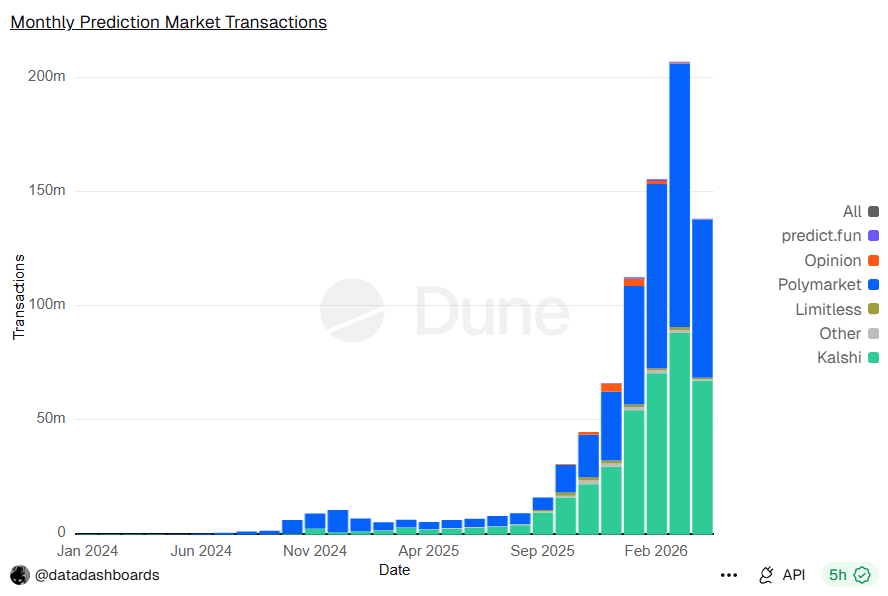
While the numbers alone don’t paint a complete picture, they do suggest there’s solid demand in the market, making it a good time for innovation. If prediction markets were small and unimportant, expanding into perpetual contracts (perps) would seem risky. However, that’s not the case – the market is big enough that leading companies are now looking for ways to grow even further.
This expansion is attracting attention from investors and market watchers. Moving beyond one-time event-based contracts to offer continuous derivatives isn’t simply adding a new feature; it signals a vision for how crypto trading could evolve. The platform is suggesting that the future of US crypto trading may resemble prediction markets more than many currently anticipate.
What traders stand to gain
The benefit for traders is straightforward: offering perpetual futures in the US reduces the need to use foreign exchanges and complex solutions. This also helps them more easily meet US reporting requirements and regulations. This could attract traders who were interested in these types of futures but hesitant to use the platforms that previously offered them.
Everyday traders might like perpetual futures contracts because they’re flexible and allow for quick reactions to market changes. Larger institutions, however, are usually more focused on having a regulated and legally sound trading environment with a solid infrastructure for meeting compliance requirements.
As I’ve researched perpetual futures contracts – or ‘perps’ – I’ve found a key characteristic is a double-edged sword. Their power comes from the ability to quickly increase your position size, which is appealing to traders. However, this same leverage means losses can accumulate just as rapidly. That’s why, as we see perps becoming more available to a wider audience, it’s becoming increasingly important to focus on educating users and implementing robust risk management tools.
What happens next
What happens next with this project won’t be determined by news or hype, but by how well the market performs. While announcements can create initial excitement, long-term success relies on things like competitive pricing, consistent service, plenty of trading activity, and proof that people continue using it beyond the first few days.
The first indicators to watch are simple:
- Trading volume after launch.
- Number of active users.
- Range of assets offered.
- Spread quality during volatile periods.
- Whether institutions show up, not just retail traders.
If these initial figures are strong, the impact could be significant. We might see more money flowing into similar investments, and new types of collateral used to back them. Other American companies could be prompted to create their own competing products. Ultimately, regulators may start viewing this area of crypto not as a niche market, but as a key example of how digital assets could function within the US financial system.
If these new offerings don’t gain traction, it would suggest people aren’t simply looking for easier access and still prefer existing international platforms. However, current signs are positive. The product is well-known, we already have an engaged user base, and the overall environment is more favorable than it’s been in a long time.
The bigger meaning of Kalshi-Polymarket race
This is essentially a story about competition. Two companies spotted a new opportunity in the crypto market and both tried to capitalize on it. One acted quickly, while the other followed with a more established and legally sound presence in the United States. Both companies are aiming to lead the future of cryptocurrency trading in America.
Ultimately, this situation highlights how the market is changing. It’s about what happens when prediction markets become mainstream, functioning more like traditional exchanges. It raises the question of whether the US can become a leading hub for this important type of crypto trading, and demonstrates how quickly clear regulations can transform an idea into a real business opportunity.
What’s exciting about this situation is that Kalshi and Polymarket aren’t just making small improvements to what they offer. They’re actually finding out if a new kind of crypto trading could take off in an area that many previously considered just a passing fad.
If these predictions hold true, April 2026 could be a turning point, marking the moment prediction markets transitioned from casual wagers to a key component of the future of American cryptocurrency trading.
Read More
- Gold Rate Forecast
- ETH PREDICTION. ETH cryptocurrency
- USD TRY PREDICTION
- Brent Oil Forecast
- Silver Rate Forecast
- USD MXN PREDICTION
- TRX PREDICTION. TRX cryptocurrency
- EUR INR PREDICTION
- Bitcoin’s Rally: The Unlikely Hero of the Financial World! 🚀💰
- EUR PLN PREDICTION
2026-04-24 19:28