A federal jury ruled against Elon Musk in his lawsuit against OpenAI and Sam Altman, dismissing all of his claims. The jury determined that Musk waited too long to file the lawsuit, exceeding the legal time limit.
-
Key Takeaways:
- A federal jury dismissed Musk’s lawsuit against OpenAI on May 18, citing a statute of limitations.
- Musk called the verdict a “calendar technicality” and plans to appeal to the Ninth Circuit Court.
- OpenAI, valued at around $730 billion pre-funding, is targeting a public market debut by end of 2026.
Verdict Reached, But Battle Not Over
A federal jury in Oakland, California sided with OpenAI on May 18, unanimously dismissing all claims in Elon Musk’s lawsuit against Sam Altman and the company he co-founded. The jury found that Musk’s claims were filed outside the three-year statute of limitations as district court judge Yvonne Gonzalez Rogers immediately adopted the advisory jury’s verdict.
The 2024 lawsuit started with Elon Musk’s claim that Sam Altman had broken a key promise to run OpenAI as a nonprofit focused on helping people. However, the court didn’t decide if that promise was ever made or broken. Ultimately, the case was dismissed because too much time had passed, meaning the court didn’t need to consider the actual facts of the situation.
Writing on X shortly after the verdict, Musk called the outcome a “calendar technicality” and confirmed he would take the matter to the Ninth Circuit Court of Appeals. His legal team formally reserved the right to appeal in open court.
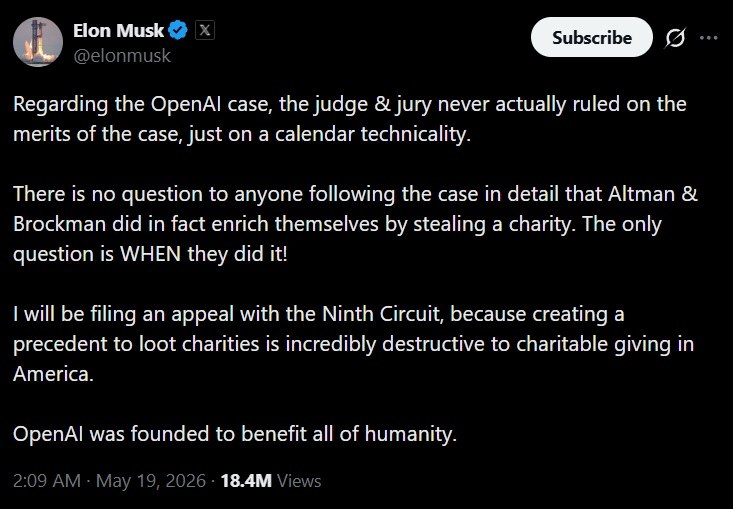
Judge Gonzalez Rogers expressed open skepticism in response, indicating she was prepared to dismiss any such appeal given the weight of evidence behind the jury’s finding.
A Two-Year Legal Feud
The verdict is just a single chapter within a broader conflict between Musk and OpenAI that has played out across courtrooms as well as social media because shortly after Musk filed his original suit, OpenAI counter-sued him, accusing Musk of waging a bad-faith legal campaign as a competitive weapon.
Elon Musk started xAI in 2023, and its Grok model is a direct competitor to ChatGPT. This created a financial motive for the lawsuit, which OpenAI’s legal team emphasized during the trial.
The backdrop to the verdict is a company that has continued scaling regardless of the courtroom drama. OpenAI is approaching a $730 billion pre-funding valuation and has targeted a public market debut before the end of 2026. The company made headlines last year (alongside Robinhood) when its name surfaced in a debate over tokenized stocks and equity exposure, a sign of how deeply its footprint now extends beyond pure AI into financial markets.
Musk’s X platform remains one of the most active venues for crypto discourse, and xAI has been actively exploring integrations spanning AI and decentralized applications. In all of this, whether the Ninth Circuit takes up the case remains to be seen because if it declines, the door on Musk’s nonprofit-breach argument closes permanently (at least through the U.S. federal court system).
Read More
- Pi Hotel Vietnam: First to Accept Pi Coin Payments in Real-World Transactions
- Silver Rate Forecast
- Warsh’s Fed Debut: A June Rate Cut? Don’t Hold Your Breath, Darling
- USD IDR PREDICTION
- Gold Rate Forecast
- USD TRY PREDICTION
- USD MXN PREDICTION
- SOL GBP PREDICTION. SOL cryptocurrency
- 3 MASSIVE Token Unlocks That Could Blow Up the Market: HYPE, ENA, RED!
- Ripple’s CEO Reveals Shocking Truth About CLARITY Act!
2026-05-19 11:27