On March 31st, Dubai’s virtual asset regulator, VARA, released an updated rulebook (version 2.1) that officially outlines regulations for crypto exchange-traded derivatives (ETDs). This is the first time formal rules have been established for these types of financial products in Dubai.
This new set of rules affects all companies in the emirate that offer cryptocurrency exchange services. It focuses on making sure customers understand the risks, limiting how much they can borrow to trade, keeping client assets separate, and providing clear information.
What Dubai’s New Derivatives Framework Requires
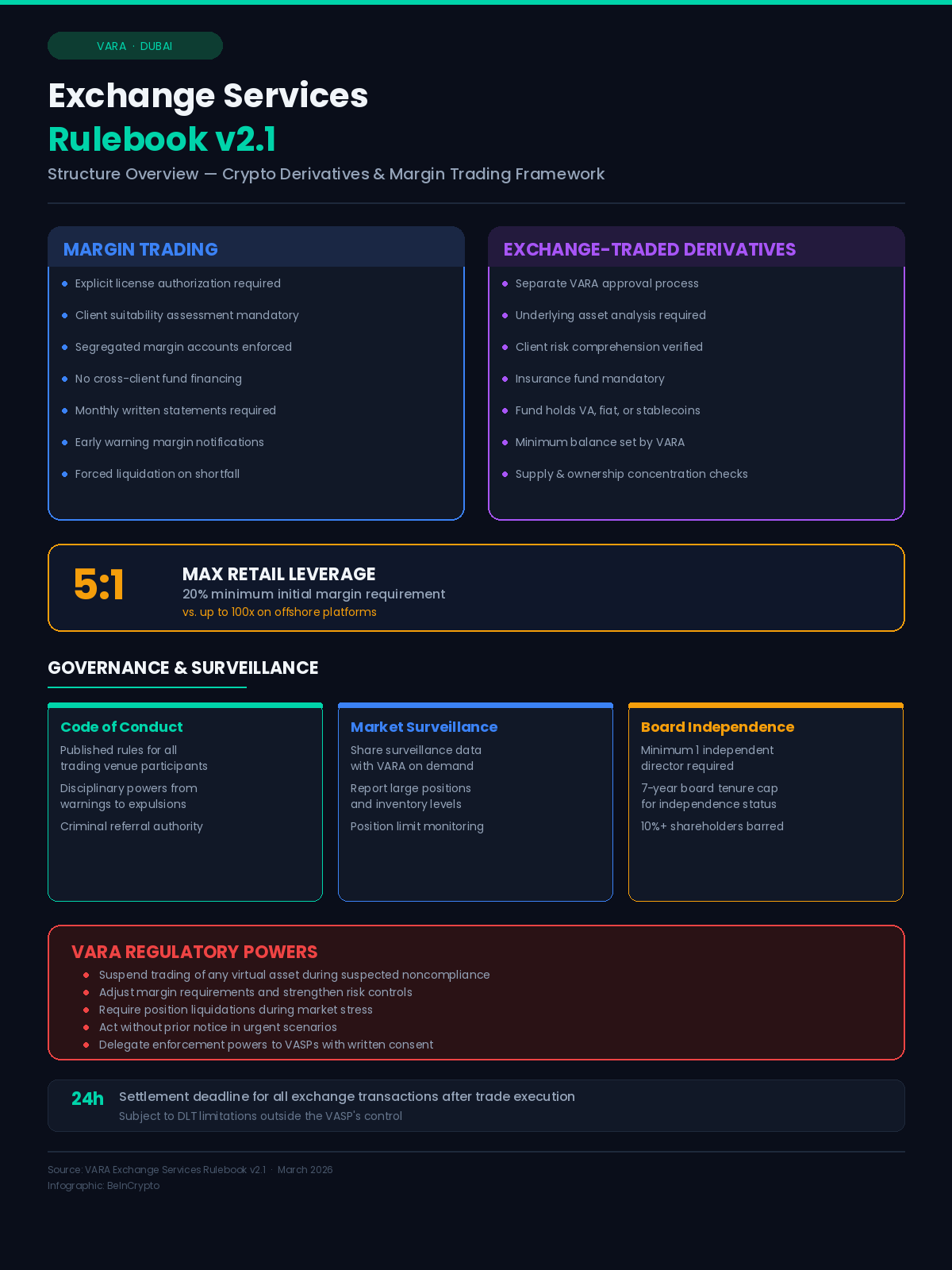
VARA now permits both large institutions and individual investors to trade crypto derivatives, but there are significant restrictions in place for individual traders to protect them.
Retail traders can borrow a maximum of five times the amount of their own capital, meaning they need to put down at least 20% of the trade value upfront. This is much lower than what’s available on some international platforms, where traders can sometimes borrow up to 100 times their capital for certain trades.
Before a virtual asset service provider (VASP) starts working with a new retail customer, they need to evaluate if the customer is financially prepared, has the necessary trading knowledge, and understands the risks involved.
Firms must restrict access where products fall outside a client’s risk profile.
Accounts used for margin trading need to be kept separate from regular trading accounts. Virtual asset service providers (VASPs) are not allowed to use one customer’s money to cover another customer’s margin trades, even if the first customer agrees.
Monthly written statements are also required.
VARA Retains Emergency Powers
The agency has given itself wide-ranging power to intervene when markets become unstable. It can take actions like temporarily stopping trading of certain products, forcing traders to close out their positions, and demanding more funds to cover potential losses.
In urgent scenarios, VARA can act without prior notice to contain market disruption.
Virtual asset service providers are required to have an insurance fund to cover their electronic transfer of digital assets services. The amount of money in this fund must meet a minimum requirement set by the governing regulator, and it can be held in virtual assets, traditional money, or approved stablecoins.
This framework expands upon Version 2.0, launched in May 2025, which initially established rules for margin trading and increased compliance requirements for Virtual Asset Service Providers (VASPs) operating in Dubai.
Read More
- Silver Rate Forecast
- Gold Rate Forecast
- EUR TRY PREDICTION
- ETH PREDICTION. ETH cryptocurrency
- ETC PREDICTION. ETC cryptocurrency
- Cardano’s Wild Ride: Is $1 the New Reality? 🧐
- Incentiv’s Testnet Triumph: When Blockchain Meets Community Love 💖💰
- Canary’s Trump Coin ETF: A Delusional Gamble? 🐦💸
- Brent Oil Forecast
- BlackRock & Binance: A Match Made in Crypto Heaven? 😇
2026-03-31 14:21