
What to know:
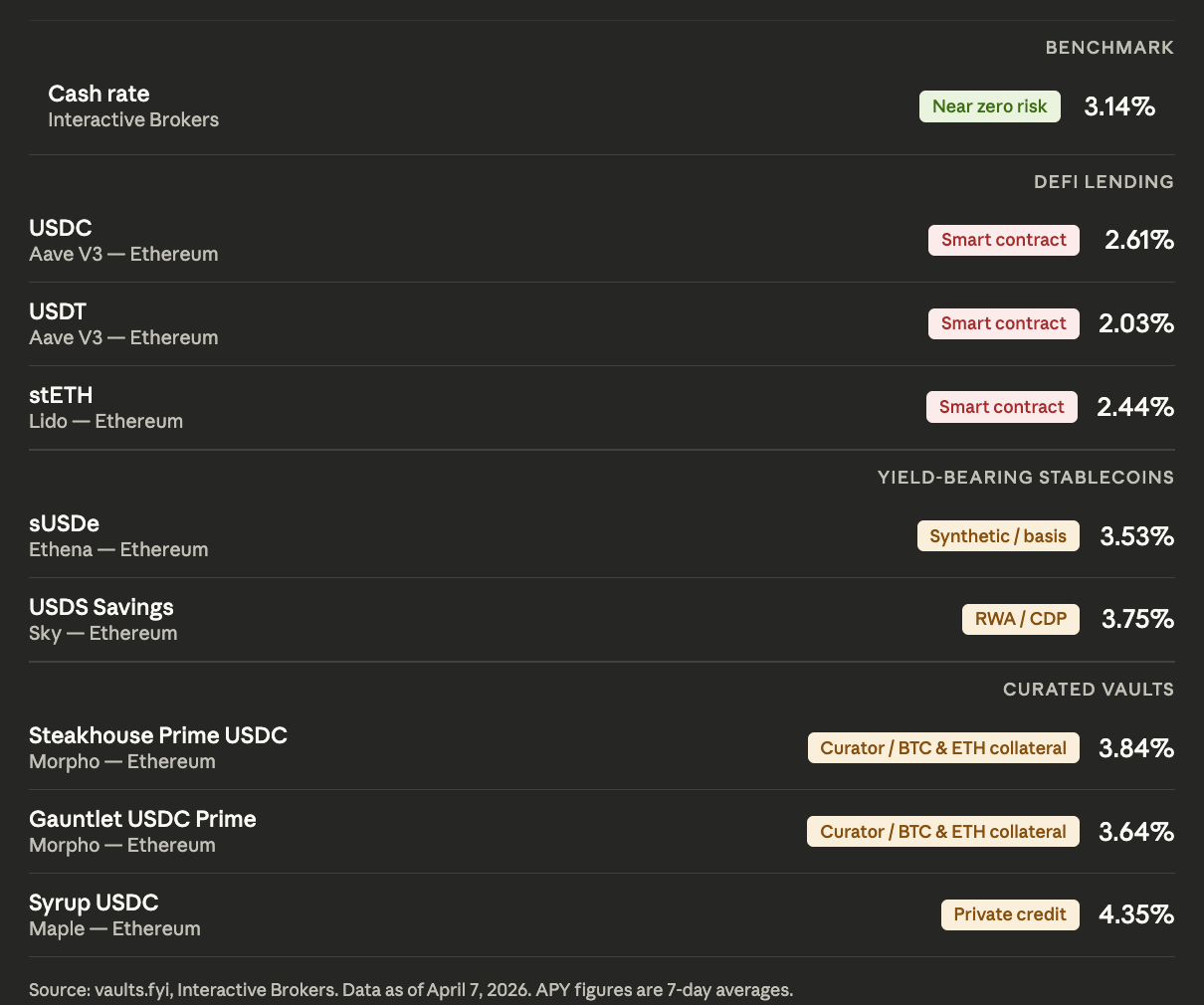
- Flagship DeFi rates have fallen below traditional finance (TradFi), with Aave’s 2.61% APY on USDC trailing the 3.14% offered by Interactive Brokers.
- Investors are absorbing high risks—including a $2.47 billion spike in 2025 exploits—for returns that no longer offer a “risk premium” over “risk-free” government rates.
- Organic on-chain yield has dried up; the remaining competitive rates (3.5%–6%) now largely depend on Real-World Assets like U.S. Treasuries and institutional credit.
People who invested in decentralized finance (DeFi) to earn easy money through high returns are now finding that those returns aren’t as profitable as they used to be.
Decentralized Finance, or DeFi, lets people do traditional banking activities – like borrowing, lending, and trading – directly on a blockchain, eliminating the need for banks. From 2021 to 2022, and even during the downturn that followed, DeFi offered very attractive returns, with some platforms like Aave offering rates around 20% and newer platforms even higher. This could be a good opportunity to earn high interest on your money, but it’s important to remember that it also comes with risks like hacking, security flaws, and the possibility of losing your funds quickly.
By 2026, Aave, a leading DeFi lending platform, offers around 2.61% annual interest on USDC deposits. Interestingly, traditional platform Interactive Brokers currently provides 3.14% on uninvested cash – a rate higher than what Aave offers. While the difference isn’t massive, it challenges a key idea behind DeFi: that you should earn more by taking on more risk. Currently, keeping funds in DeFi means facing similar or higher risks, but potentially earning less.
On March 22nd, trader James Christoph posted on X, saying that with DeFi, you might earn slightly less than you would with Treasury bills, but you also risk losing everything once a year.
That direct observation points to a larger change happening in the market. For a long time, decentralized finance (DeFi) attracted users by promising greater profits, even if it meant taking on more risk. Now, it’s becoming increasingly difficult to argue that those higher returns are worth the risks involved.
Where the yield went
It was not always this way.
In 2024, the returns offered by decentralized finance (DeFi) platforms were surprisingly good. Ethena, a system that creates a digital dollar called USDe using various assets and risk management techniques, briefly offered over 40% annual interest on its sUSDe product, attracting billions of dollars in investment. However, these high returns were mostly due to temporary incentives using ENA, Ethena’s own cryptocurrency, and specific trading methods that couldn’t be sustained long-term.
Ethena’s annual percentage yield (APY) has dropped to about 3.5%, and the value of assets held within the platform (TVL) has decreased from a high of around $11 billion to $3.6 billion. Ethena had not responded to a request for comment at the time this was published.
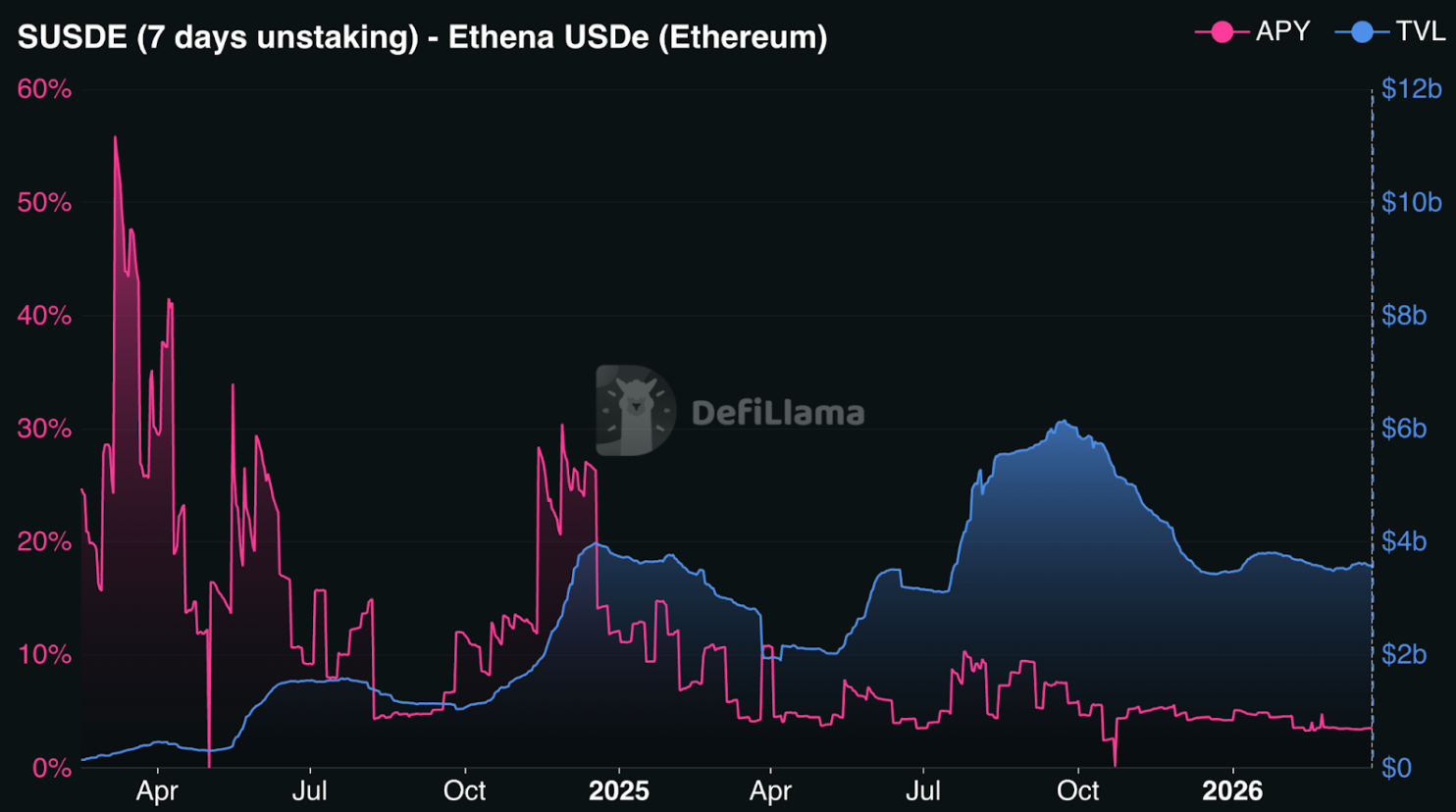
Across the rest of the stablecoin lending market, yields have followed a similar path lower.
The biggest pool of USDT on Aave currently offers a 1.84% return, and many other options earn less than 2%. The additional rewards that used to significantly increase earnings have mostly gone away. Now, returns are based solely on how much people borrow, and that demand isn’t high enough to increase yields.
Recent data from vaults.fyi reveals a significant drop in returns for popular crypto deposits. Aave, a leading lending platform, is currently offering just over 2% interest on its two biggest stablecoin pools – USDT and USDC – which hold a combined $8.5 billion. Lido’s stETH, the largest deposit pool, yields 2.53%, and Ethena’s staked USDe has fallen to 3.47%.
Very few platforms currently offer better interest rates than Interactive Brokers’ 3.14%. The ones that do are mostly private lending options or investments linked to tangible assets. For example, Sky’s USDS Savings rate of 3.75% is becoming a popular choice, offering a higher return than Aave and attracting $6.5 billion in deposits.
However, there’s a catch: most of Sky’s revenue – about 70% – comes from traditional sources like U.S. Treasury products, loans to institutions, and rewards from Coinbase USDC. This is important for investors who chose DeFi to avoid these types of traditional financial assets.
While Aave is best known for its USDC rates, it offers better returns on some other stablecoins. Currently, sGHO yields 5.13%, and other options within Aave’s V3 Core Ethereum include USDG at 5.9%, RLUSD at 4.4%, and USDTB at 4.0%. However, these rates are often overlooked when comparing Aave to other platforms.
Paul Frambot, who helped create the lending platform Morpho, believes the recent drop in yields was predictable.
He explained to CoinDesk that when loans are all essentially the same – backed by the same collateral and offering the same terms and results – interest rates tend to fall to levels similar to risk-free investments. This happens because there’s little opportunity to differentiate and earn higher returns.
Morpho manages over $10 billion in deposits and operates differently from traditional platforms. It allows expert teams, called curators, to create specialized lending pools – called vaults – with customized risk levels, collateral options, and ways to earn yield. These curated vaults can offer attractive returns; for example, the Steakhouse Prime USDC and Gauntlet USDC Prime vaults currently yield 3.64%, and Sentora’s PYUSD vault is yielding 6.48%.
Frambot explains that the key difference lies in risk management. He says the ‘vault and curator’ model allows for open competition in identifying and managing risks, unlike traditional methods. This creates a more dynamic marketplace where investment returns are based on the effectiveness of investment strategies, not just the amount of money involved. As a result, Morpho typically offers higher returns on leading stablecoins, supported by solid assets like Bitcoin and Ethereum.
Still, the yields are nowhere near what they were in previous years.
Aave believes the recent slowdown is temporary, not a fundamental problem with the protocol. They attribute the decrease in borrowing to unusually negative feelings in the crypto market – currently lower than even during the lows of 2022 – which is also impacting deposit rates. According to a spokesperson, stablecoin rates on Aave tend to follow borrowing activity and are not expected to remain low in the long term.
Despite recent changes, the company highlights that its average stablecoin deposit returns over the last year remain higher than those offered by Interactive Brokers. This means customers who deposited funds before 2025 would still see a positive return on their investment today.
‘Really dark’
Lower yields, though, are only part of the story. Confidence across DeFi has also taken a hit.
Balancer Labs, a well-known company building tools for decentralized exchanges, recently closed down following a $110 million security breach. This, along with generally low prices for governance tokens, has created a sense of discouragement within the industry.
DeFi investor Jai Bhavnani recently shared on X that the cryptocurrency space is facing tough times. He described a worrying combination of factors – decreasing returns, projects closing down, and recent security breaches – as creating a particularly difficult situation.
From my observations, limited partners are increasingly finding that many DeFi protocols don’t offer enough potential return to justify the risks involved. And, as far as I can tell, there aren’t any upcoming developments that seem likely to change this situation.
Others in the discussion disagreed, pointing out that market crashes often eliminate failing projects, allowing stronger, more sustainable ones to survive. This has happened before – DeFi has weathered previous downturns and come out stronger. While that may be historically accurate, it doesn’t help investors who are currently seeing lower returns.
Beyond that, there’s the risk associated with smart contracts – specifically, the increasing number of potential problems that standard audits simply miss.
Last month, a security breach at Resolv, a platform for a type of stablecoin that earns interest, resulted in a loss of about $25 million. A hacker exploited a weakness in the system by depositing $100,000 USDC and receiving $50 million worth of USR – 500 times the intended amount. The problem wasn’t a bug in the code itself, but rather a lack of essential security measures like verifying data from external sources and setting limits on how much new currency could be created.
The protocol currently has $113 million in assets, but owes $173 million, resulting in a deficit. USR, a digital asset, is currently worth $0.13 after losing its intended value of $1.00 and continuing to decrease in price as March ends.
The recent hack of Resolv is part of a growing trend of cryptocurrency theft. In just the first six months of 2025, hackers stole over $2.47 billion in crypto, surpassing the total amount stolen in all of 2024, according to a report by CertiK. A large portion of these losses—$1.7 billion—came from compromised wallets. Mitchell Amador, CEO of Immunefi, explained to CoinDesk that while the underlying code for these systems is becoming more secure, hackers are finding new ways to attack. They’re now focusing on things like exploiting human error, stealing private keys, and tricking people. A recent example is the $270 million hack of the Drift protocol, which was linked to a social engineering campaign orchestrated by North Korea.
When investors compare the 2-3% returns from DeFi to the 3.14% offered by traditional brokers, the difference isn’t as significant as it used to be. The higher potential gains that once made DeFi attractive have largely vanished.
Comparing deposit rates doesn’t give the whole picture. According to an Aave representative, Aave currently offers significantly better borrowing rates than IBKR – 3.2% on Aave compared to up to 6.14% on IBKR. Aave also lowers borrowing costs for its users because the collateral they provide continues to earn rewards, something IBKR doesn’t offer.
Regulatory ‘Clarity’
Beyond lower returns and ongoing security concerns, DeFi is now also dealing with potential regulations that could impact how it generates those returns.
The proposed Digital Asset Market Clarity Act, a major bill for the crypto industry, could ban rewards earned just for holding stablecoins (tokens pegged to the dollar). While rewards from *using* stablecoins – like for making payments – would likely still be permitted, the details are currently vague. Industry experts who have seen the draft have called it “overly narrow and unclear.”
Markus Thielen from 10x Research recently suggested that the proposed Clarity Act could shift profits and investment back towards traditional financial institutions and regulated products, potentially hindering the growth of decentralized finance (DeFi).
The debate over DeFi regulations in the bill is still ongoing, as some Senate Democrats are worried about illegal financial activity. And with DeFi investments already becoming less profitable and riskier, it looks like Washington may be considering rules that could further limit opportunities.
This puts DeFi in a difficult position. Returns are lower, risks still exist, and upcoming regulations could further reduce potential earnings.
For now, the math that once drew investors in is looking much less convincing.
Read More
- Gold Rate Forecast
- Brent Oil Forecast
- USD ZAR PREDICTION
- Bitcoin’s MACD Turns Red-Bulls Beware!
- Mastercard’s Billion-Dollar Bet: A Fax Machine in a Blockchain World
- Bitcoin’s Buy Zone: Closer Than Ever? Or Just a Trick?
- Investors Panic as Bitcoin ETFs Suffer Shocking $171M Outflow Amid Rising Geopolitical Tensions!
- US DOJ Shuts Down Crypto Unit: Who Let the Banter Out? 😎
- Kraken’s Wild Ride: From Crypto to Stocks, Because Why Not? 🐙📈
- Traders Rush Back to XRP: The Silent Storm Brewing in the Crypto World! 😱🚀
2026-04-07 18:27