A New York lawsuit is currently attempting to wrestle control of tens of thousands of Bitcoin addresses that appear to be taking a very long nap. According to one outside analysis (likely conducted by someone with a spreadsheet fetish), these slumbering wallets collectively hold about 3.79 million BTC. The plaintiffs-Noah Doe, and two Wyoming LLCs with names that scream “I made this up on a dare”-argue that if you haven’t moved your Bitcoin in years, it’s fair game for legal reassignment. New York’s lost-and-found laws, they claim, apply equally to cash and cryptocurrency. Or, as one wag put it: “If your socks can be considered abandoned property, so can your Bitcoin.”
The filing, submitted to the Supreme Court of the State of New York (County of New York, because nothing says “justice” like a bureaucratic postcode), names ABC Company, XYZ Company, and Noah Doe as plaintiffs. The respondents? John Does 1-39,069. Yes, that’s 39,069 John Does. Why not just name the moon and call it a day? The case isn’t a court order awarding ownership-it’s a summons and amended complaint seeking “declaratory relief,” which is lawyer-speak for “please, please, please admit we’re right.”
According to the complaint, Doe allegedly identified three groups of dormant wallets between December 2024 and April 2025. The first group had 1,625 wallets, but duplicates were excluded-because even Bitcoin can’t be trusted not to copy-paste. The second group had 546 wallets. The third group? A staggering 39,911 wallets. After some exclusions and alleged owner responses (probably a few people panicking and sending a transaction just to prove they’re not dead), the case now concerns 39,069 wallets. That’s enough to fill a stadium… or a very large Excel sheet.
The plaintiffs argue that Doe reported these wallets to the NYPD using USB drives. The police returned the drives, presumably because they didn’t want to be blamed if someone tried to plug them into a toaster. The filing claims this satisfied New York’s lost-property procedures, and that title vested in Doe under New York Personal Property Law § 257. Which is all well and good unless you remember that Bitcoin isn’t a lost sock in a laundromat-it’s more like a sock that’s been encrypted, hidden in a vault, and then buried in a time capsule. But hey, who needs logic when you’ve got paperwork?
A New York suit by “Noah Doe” and two Wyoming LLCs seeks a court order confirming their ownership of 39,069 long-dormant Bitcoin wallets, arguing the wallets are legally “abandoned” property they found, reported to NYPD, noticed on-chain and in the press, and then claimed…
– Sani | TimechainIndex.com (@SaniExp) May 24, 2026
The legal argument is as unusual as a cat walking into a library and demanding a book on quantum physics. It treats dormant Bitcoin addresses as recoverable property, despite the obvious fact that without a private key, even the most determined scavenger hunt ends in disappointment. The filing compares wallets to bank accounts, which is like saying a bicycle is a car because they both have wheels. But Bitcoin-native observers are already rolling their eyes, because ownership of a bank account and control over a self-custodied Bitcoin UTXO are about as similar as a snowball in hell.
The background to the lawsuit traces back to a Salomon Brothers Strategic Advisors campaign that sounds like a mix of public service and corporate theater. The complaint says Doe retained Salomon Brothers in February 2025 as a consultant to “notify potential wallet owners.” Meanwhile, a cyber/blockchain expert sent messages to wallet holders using OP_RETURN, while Salomon Brothers hosted a notice webpage. The firm later described the effort as an attempt to “secure wallets” for the greater good. Because nothing says “greater good” like sending 41,523 OP_RETURN messages to 39,423 wallets, giving owners 90 days to respond by either moving their coins or filling out a form. It’s like a cosmic version of a “Your package is at the door” notification-except the package is worth millions and the recipient might not even be alive.
Salomon Brothers, for the record, is not the historic Wall Street firm that became part of Citigroup. It’s a newer organization that somehow acquired the name. Their website describes them as an “alliance of professional practices” offering services like financial advisory and real estate finance. Which is all very respectable until you realize their most notable achievement is spearheading the “Great Bitcoin Dusting” campaign, as dubbed by Galaxy Research. Because why dust your house when you can dust the blockchain instead?
Galaxy’s analysis of the campaign noted that 98.82% of the notified addresses were legacy P2PKH addresses, with an average dormancy of about 5.95 years. That’s a long time to leave money unattended, especially if you’re not Satoshi Nakamoto. Sani, however, points out that many of these notifications were sent to P2PKH versions of addresses with only dust balances, while the real wealth sits in older P2PK outputs. If true, this means the plaintiffs might be trying to claim property they never actually reached. It’s like writing a letter to a post office box that no longer exists and then suing the postman for not delivering it.
The case now sits at the intersection of legal doctrine and protocol reality. The plaintiffs want the court to declare inactivity as abandonment, but Bitcoin users know an address can be dormant for many reasons: the owner is dead, the keys are lost, or the holder simply doesn’t care to move the coins. On-chain, these scenarios look identical, which is probably why the court will need a magnifying glass and a team of philosophers to figure it out.
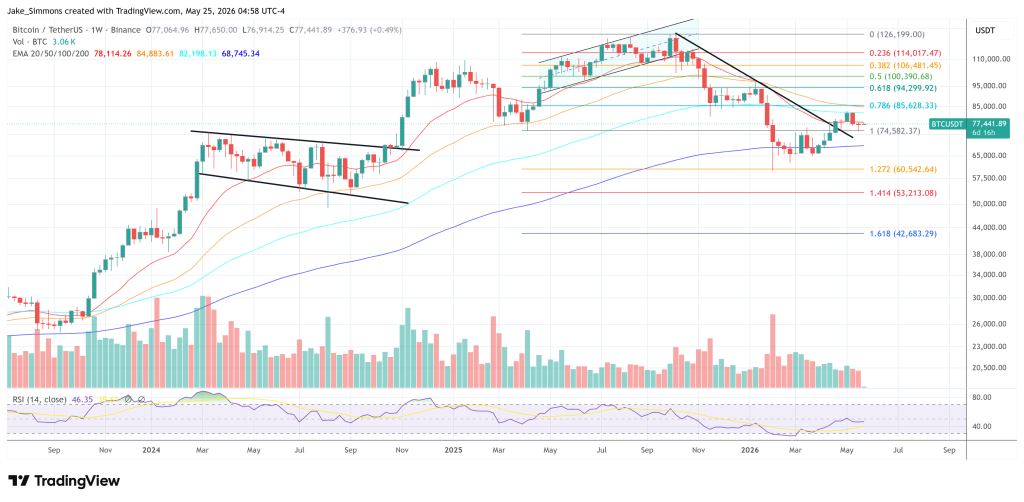
At press time, BTC traded at $77,441. Which is just enough to buy a lifetime supply of coffee… assuming you don’t get sued for the beans.
Read More
- Pi Hotel Vietnam: First to Accept Pi Coin Payments in Real-World Transactions
- TAO PREDICTION. TAO cryptocurrency
- USD TRY PREDICTION
- Silver Rate Forecast
- Brent Oil Forecast
- PI PREDICTION. PI cryptocurrency
- EUR CLP PREDICTION
- IP/USD
- EUR CNY PREDICTION
- USD ILS PREDICTION
2026-05-25 15:20