The price of Bitcoin dropped sharply today after it failed to break through the $82,500 level, leading to widespread selling in the cryptocurrency market. The decline gained speed as large investors became more cautious, Bitcoin ETFs saw significant money leaving, and highly leveraged traders were forced to close their positions.
As a researcher tracking Bitcoin, I’ve observed a notable correction recently – one of the largest short-term drops we’ve seen in weeks. This happened at a key time for the market. Bitcoin had been consistently recovering from its February lows, showing increasing bullish momentum with each rise. However, the price couldn’t break through the 200-day moving average, which quickly changed market sentiment and caused many traders to shift to more cautious strategies.
Experts believe the recent price drop wasn’t caused by one specific event. Instead, several factors combined to create a sharp decline: less demand from exchange-traded funds, decreasing activity on the blockchain, forced selling of positions, and general economic worries. This pullback now puts Bitcoin at a key point, and its next move could be significant.
Why Bitcoin Price is Crashing Today?
A combination of negative factors hit Bitcoin at the same time, causing increased price swings and making its immediate future look less stable.
Spot Bitcoin ETF Outflows Trigger Institutional Weakness
A major reason Bitcoin’s price fell today was a surprising shift in the flow of money into and out of spot Bitcoin ETFs. Market data shows these ETFs saw over $630 million in net outflows on May 13th – one of the biggest drops in recent weeks. Notably, products linked to BlackRock accounted for almost $285 million of that selling.
Bitcoin spot ETFs experienced a net outflow of $630.4 million on May 13th. Notably, clients of BlackRock sold $284.7 million worth of Bitcoin ($BTC).
— DustyBC Crypto (@DustyBC) May 14, 2026
Money flowing into Bitcoin exchange-traded funds (ETFs) has been the main force behind the recent price increase, especially from institutional investors. When lots of money flows *in*, Bitcoin’s price usually keeps going up. But when large amounts of money flow *out* of ETFs, it tends to push prices down and make investors less confident. This recent outflow was especially bad timing, as Bitcoin was already having trouble breaking through a key price level.
Weakening On-Chain Demand Reduced Market Support
Before the recent price drop, on-chain data indicated that Bitcoin accumulation was slowing down. Analysts noted that the amount of Bitcoin moving onto exchanges stayed about the same, but withdrawals from exchanges decreased significantly compared to the beginning of May. This drop in withdrawals often suggests that investors are less confident in buying and holding Bitcoin for the long term.
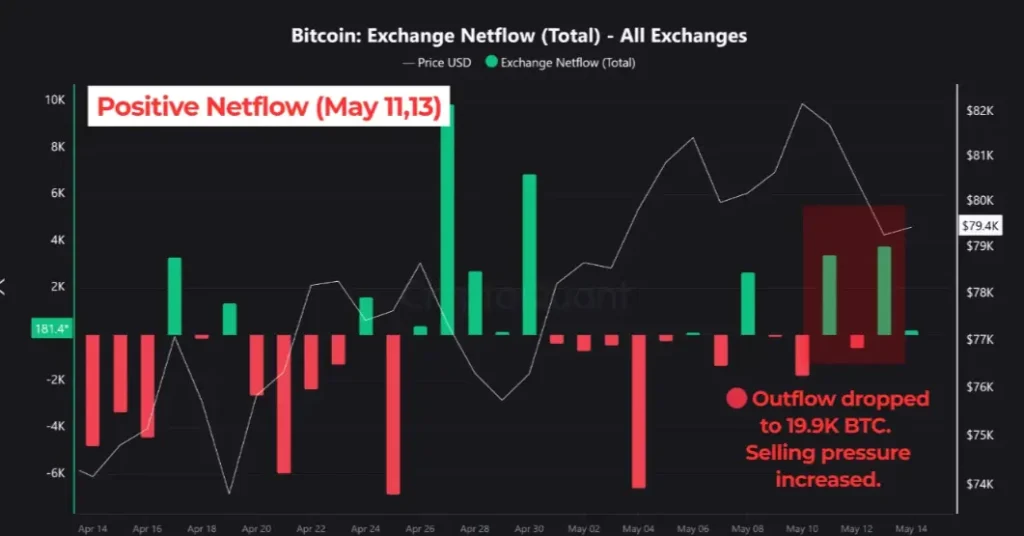
Experts observed that decreasing amounts of money leaving the market made Bitcoin more susceptible to price drops when selling began. The weakening demand meant the market struggled to handle the usual ups and downs during the recent price correction.
Long Liquidations Accelerated the BTC Dump
The derivatives market made the recent price drop much worse. From May 8th to May 10th, traders were taking on more and more risk with borrowed money, even though the market was already starting to slow down. When Bitcoin’s price began to fall, these risky bets quickly unraveled, leading to over $109 million in liquidations – forced selling of positions – across various exchanges in just three days.
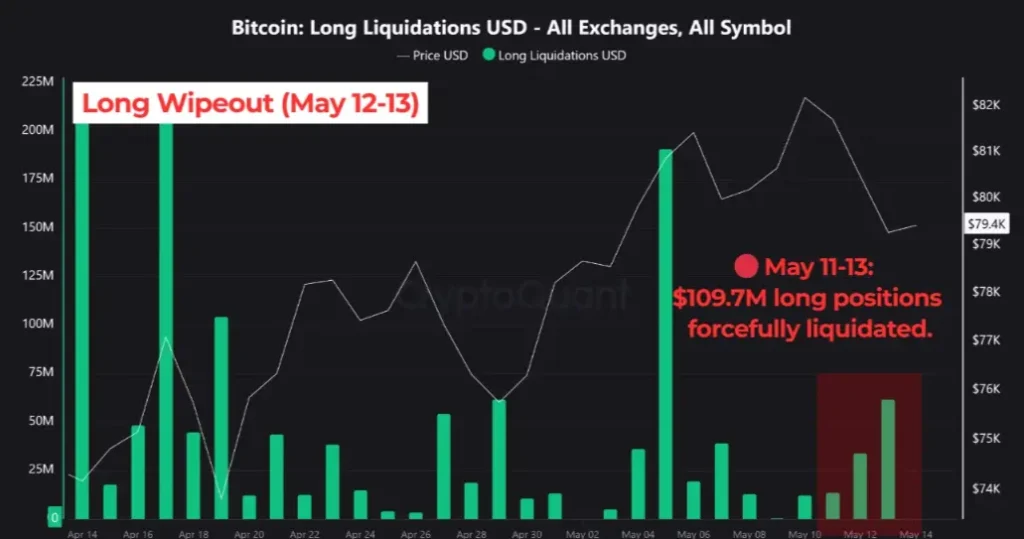
On May 12th, liquidations of long positions were about eleven times larger than those of short positions, showing strong bullish sentiment near a key resistance level. This led to a chain reaction where forced selling of overleveraged positions increased market volatility and sped up the price decline, making the correction more severe than typical market weakness.
Macro Uncertainty Added Additional Pressure
Overall economic conditions also made investors more risk-averse. Markets were hesitant as they awaited important US inflation reports like the CPI and PPI, and concerns about where the Federal Reserve would set interest rates continued to put pressure on investments worldwide.
The crypto market is still very reactive to broader economic factors, particularly those affecting the availability of money. If inflation stays high or interest rate cuts are postponed, investors tend to pull back from risky investments like Bitcoin and other cryptocurrencies. This, along with decreased investment from institutions and technical indicators suggesting a downturn, has put further strain on an already vulnerable market.
Bitcoin Price Analysis: Can BTC Retain $82K Mark?
Bitcoin’s recent price drop started after it failed to break through a key resistance level around $82,000, near its 200-day moving average. For weeks, Bitcoin had been steadily recovering, making higher lows and regaining ground on important moving averages. While buyers tried to push the price higher, they couldn’t maintain the upward trend when selling increased.
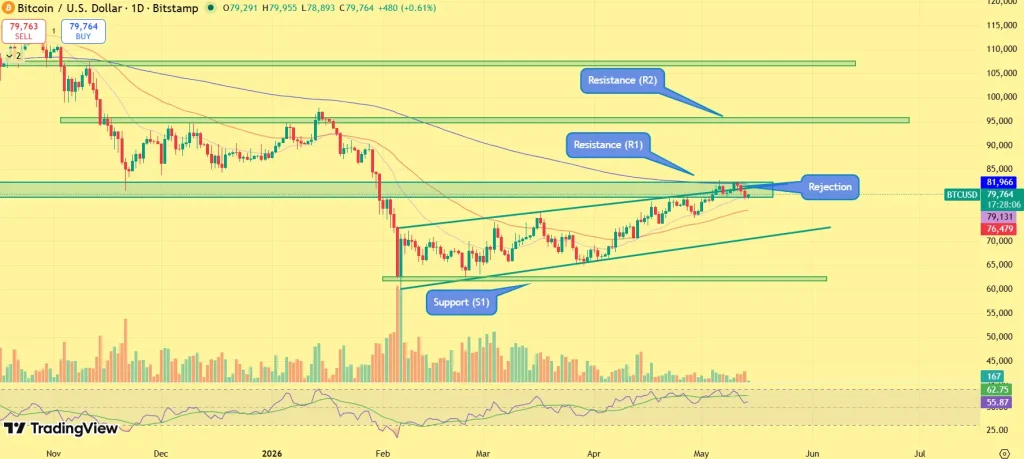
Bitcoin is currently finding support around $75,000 to $76,000, a level that coincides with its 50-day moving average and a previous period of stable trading. If this support level fails, the price could fall further in the near term. To regain upward momentum and potentially reach $90,000–$95,000, Bitcoin needs to break back above the $82,000 resistance level.
Read More
- Gold Rate Forecast
- Brent Oil Forecast
- EUR CNY PREDICTION
- GBP CAD PREDICTION
- PEPE PREDICTION. PEPE cryptocurrency
- Silver Rate Forecast
- IP/USD
- SUI’s $1.04 Flirtation Ends in $1.02 Regret
- FLR PREDICTION. FLR cryptocurrency
- Pi Hotel Vietnam: First to Accept Pi Coin Payments in Real-World Transactions
2026-05-14 09:55