Ah, Wall Street and its crypto shenanigans-a tale as old as time itself (or at least as old as the internet). BlackRock, that financial behemoth, boasts nearly $150 billion in digital asset-linked AUM in its 2026 chairman’s letter. Public companies are hoarding over 1.1 million BTC on their balance sheets, and institutions are flaunting 513,000 BTC through ETF wrappers. Impressive, right? Or just a lot of zeros to make us feel inadequate.
But let’s cut through the financial jargon and ask the real question: Who’s actually holding what, and why are they hiding it behind layers of infrastructure more complex than a Discworld tax code?
This article, my dear reader, will take you on a wild ride through Wall Street’s crypto ownership, mapped across five layers. We’ll start with SEC 13F filings (because bureaucracy loves paperwork), dive into corporate balance sheets (where the real tea is spilled), follow the money into tokenized fund rails (fancy words for “digital piggy banks”), trace the custodial chokepoints (where keys are more guarded than the Unseen University’s library), and finally, end up in the shadowy world of on-chain OTC flows (where filings go to die, and secrets thrive).
SEC 13F Filings: Where Wall Street’s Crypto Secrets Are Only Slightly Less Boring Than a Troll Tax Audit
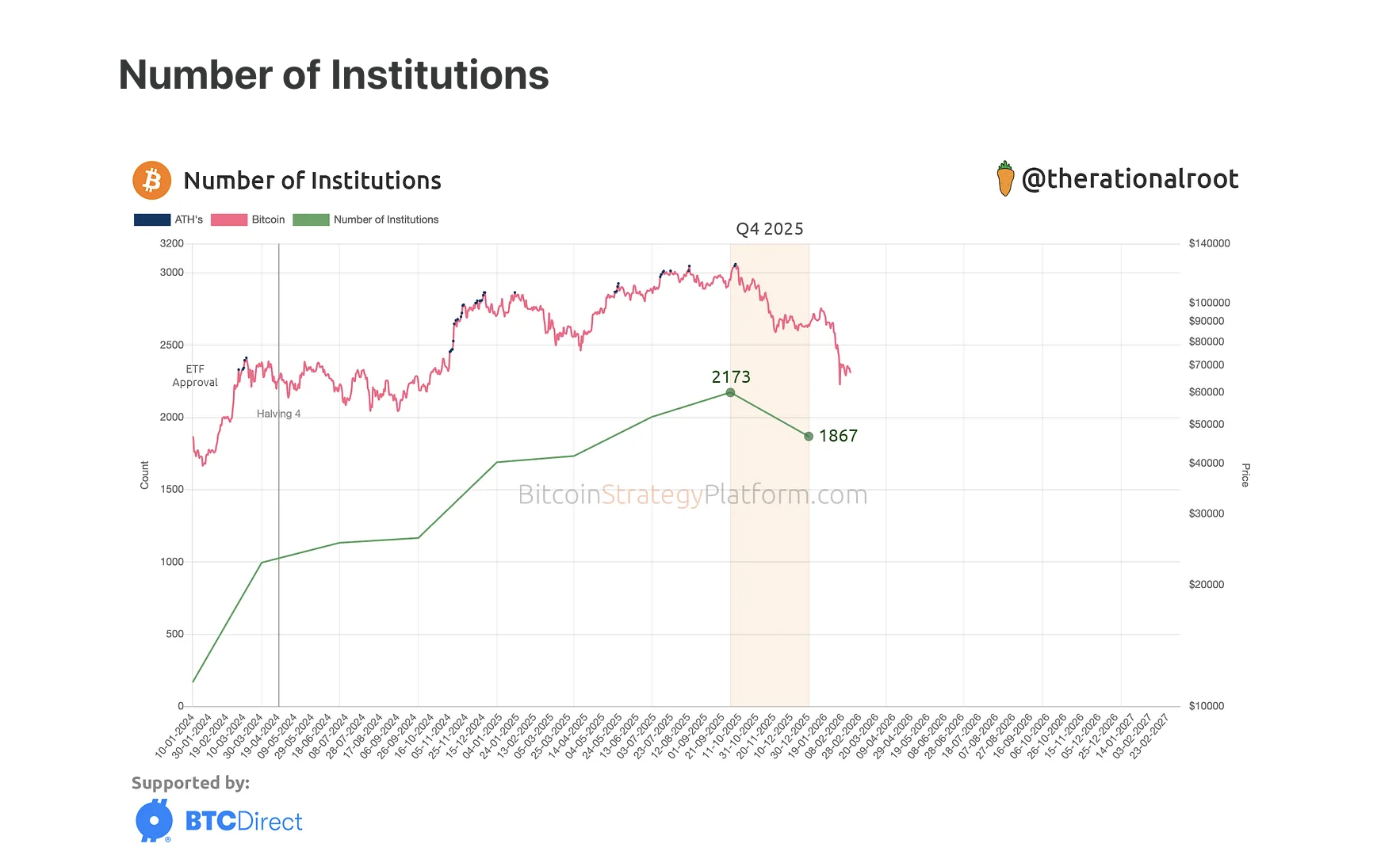
Despite Bitcoin’s 23% price nosedive in Q4 2025, global Bitcoin ETF flows stayed stubbornly positive at $3.7 billion. Professional ETF ownership grew 32%, while the broader investor base only managed 18%. Institutions still clutched over 513,000 BTC through ETFs, though the number of filers shrank from 2,173 to 1,867. Probably because the rest were too busy counting their losses.
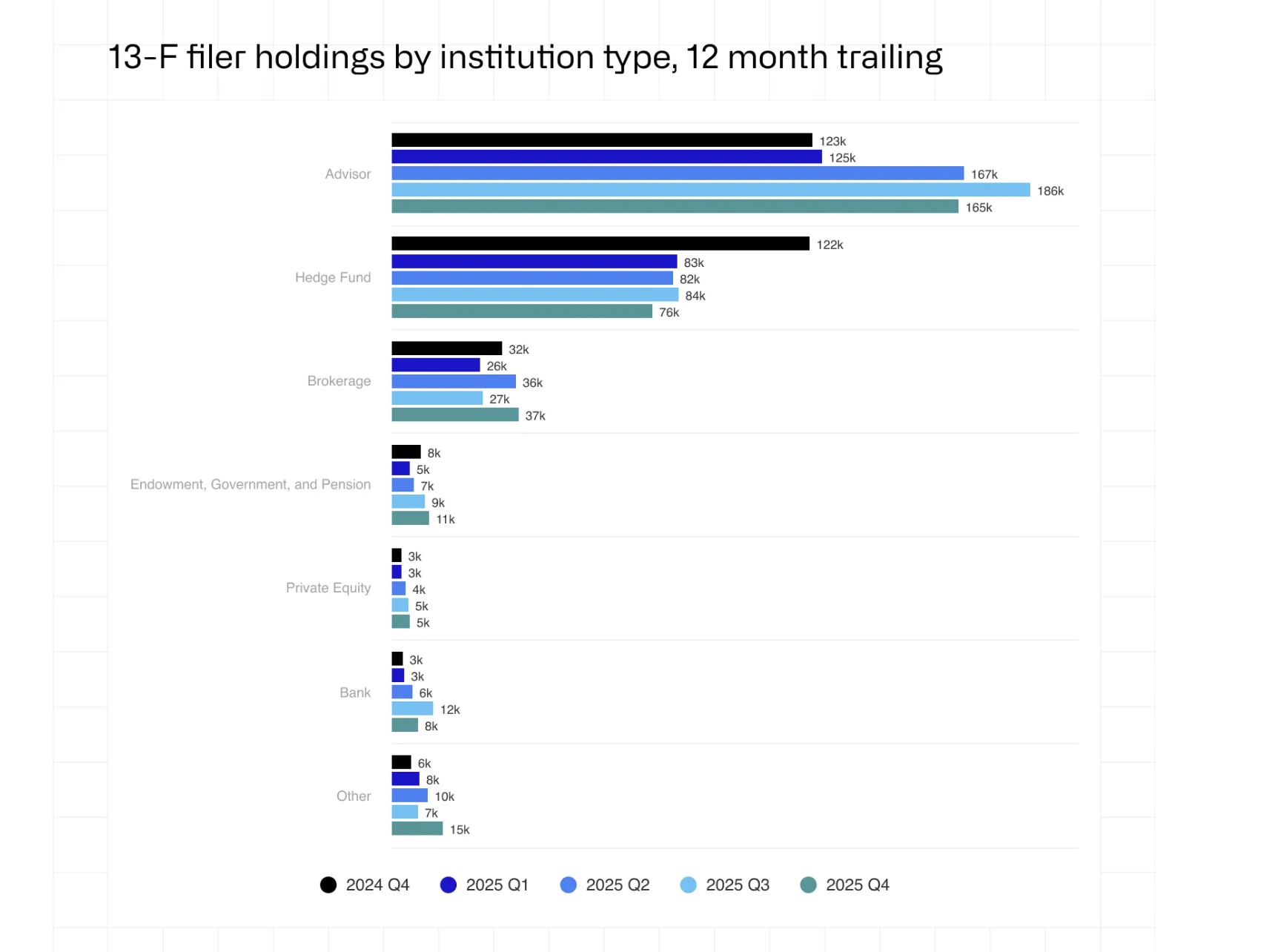
Not all of this is “conviction capital,” mind you. The basis trade-a strategy involving a long spot ETF position paired with a short CME futures position-has been the institutional darling since ETF approval. Hedge funds, however, cut their exposure by nearly 10% in Q4, as leverage unwound faster than a wizard’s spell gone wrong.
Cohort rotation, not capitulation, defined Q4. Millennium added 8,100 BTC (because why not?), Abu Dhabi’s Mubadala chipped in 2,300 BTC, and Morgan Stanley tossed in 1,900 BTC. Even Dartmouth joined the party, becoming the fourth Ivy League endowment to dip its toes into the crypto pool. Meanwhile, Brevan Howard dumped 17,700 BTC, Harvard trimmed 20%, and Royal Bank of Canada said, “Nope, we’re out,” as noted in the CoinShares Q4 2025 report.
Pension funds and endowments hit a peak of $1.48 billion in Q3 2025, only to tumble to $965 million in Q4. But hey, at least they’re consistent in their inconsistency.
ETFs, however, only tell you who’s buying the wrapper. For those holding the actual asset, corporate balance sheets spill the beans.
Corporate Treasuries: Where Bitcoin Lives Rent-Free on Balance Sheets
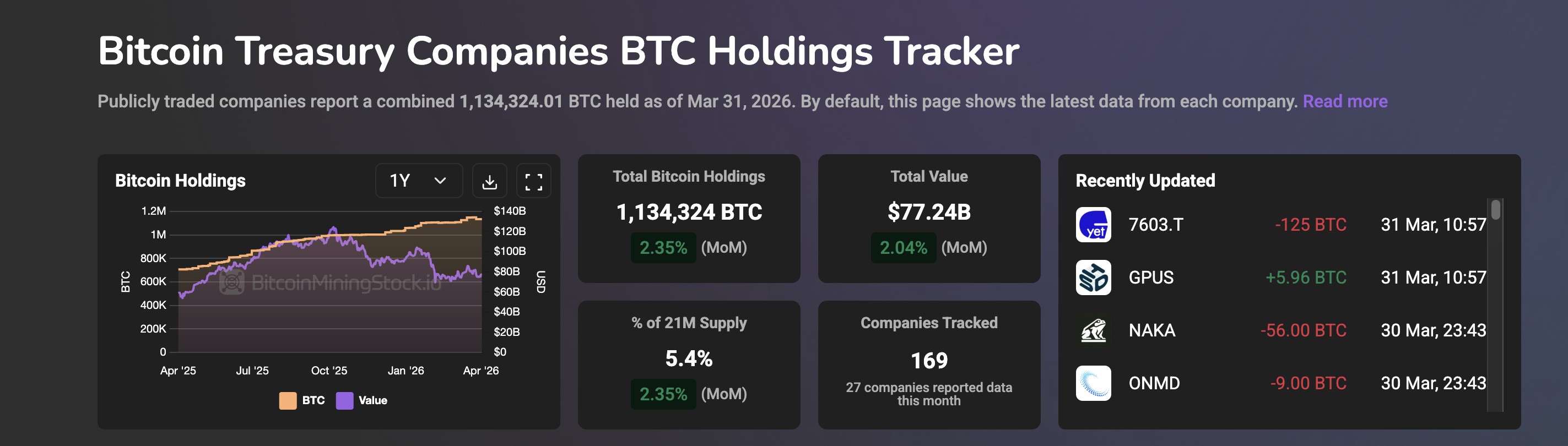
Beyond ETFs, a growing number of public companies are hoarding Bitcoin like it’s the last slice of pizza at a party. As of March 31, 2026, publicly traded companies report a combined 1,134,324 BTC on their balance sheets. That’s a lot of digital cheese.
The concentration is extreme. Strategy Inc (formerly MicroStrategy) held 762,000 BTC as of April 2, 2026. Other big players include Twenty One Capital, MARA Holdings, and Japan’s Metaplanet. Because nothing says “diversification” like putting all your eggs in one blockchain basket.
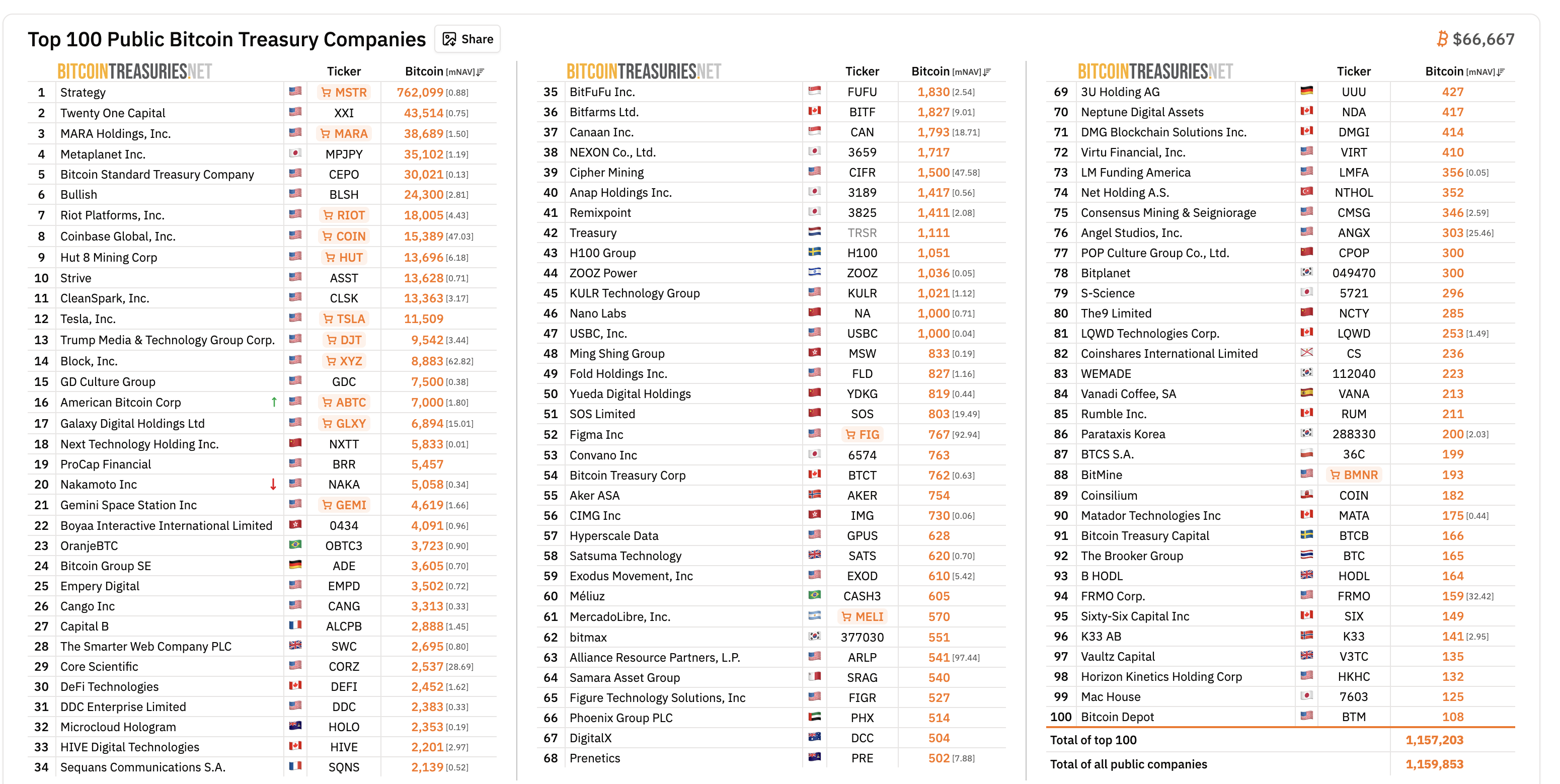
New entrants are shaking things up. Trump Media (DJT) held 11,542 BTC before pledging 2,000 BTC as collateral under a hedge arrangement with rehypothecation rights (fancy words for “we’re using your Bitcoin as a loan”). MARA sold 15,133 BTC in March 2026 at a loss to service debt. Because nothing says “financial stability” like selling your crypto at a discount.
🚨 Arkham Analyst Corrects: Trump Media Didn’t Sell 2000 BTC, It Was Transferred as Collateral
Arkham analyst Emmett Gallic has corrected his previous statement regarding Trump Media & Technology Group (TMTG) selling 2000 BTC. Gallic has deleted the original tweet and clarified…
– 0xzx (@0xzxcom) February 28, 2026
But corporate treasuries only show direct spot ownership. Wall Street’s big players are building crypto exposure through a different mechanism-one that doesn’t require holding a single Bitcoin. How very clever.
Tokenized Funds: Where TradFi Meets Blockchain and Pretends to Be Cool
Some of Wall Street’s largest firms are now building crypto exposure without touching a single token. Instead, they’re tokenizing traditional assets and putting them on-chain. Because why own the real thing when you can own a digital representation of it?
BlackRock’s BUIDL fund, a tokenized US Treasury money market product, reached $2.85 billion in total assets ($2.17 billion at press time). In February 2026, BlackRock started trading BUIDL on Uniswap’s decentralized exchange and even bought UNI governance tokens. Their first dip into DeFi, and they’re already acting like they invented it.
The firm’s 2026 chairman’s letter reported $65 billion in stablecoin reserves, $80 billion in digital-asset ETPs, and nearly $150 billion in total digital asset-linked AUM. Because nothing says “we’re serious about crypto” like throwing around big numbers.
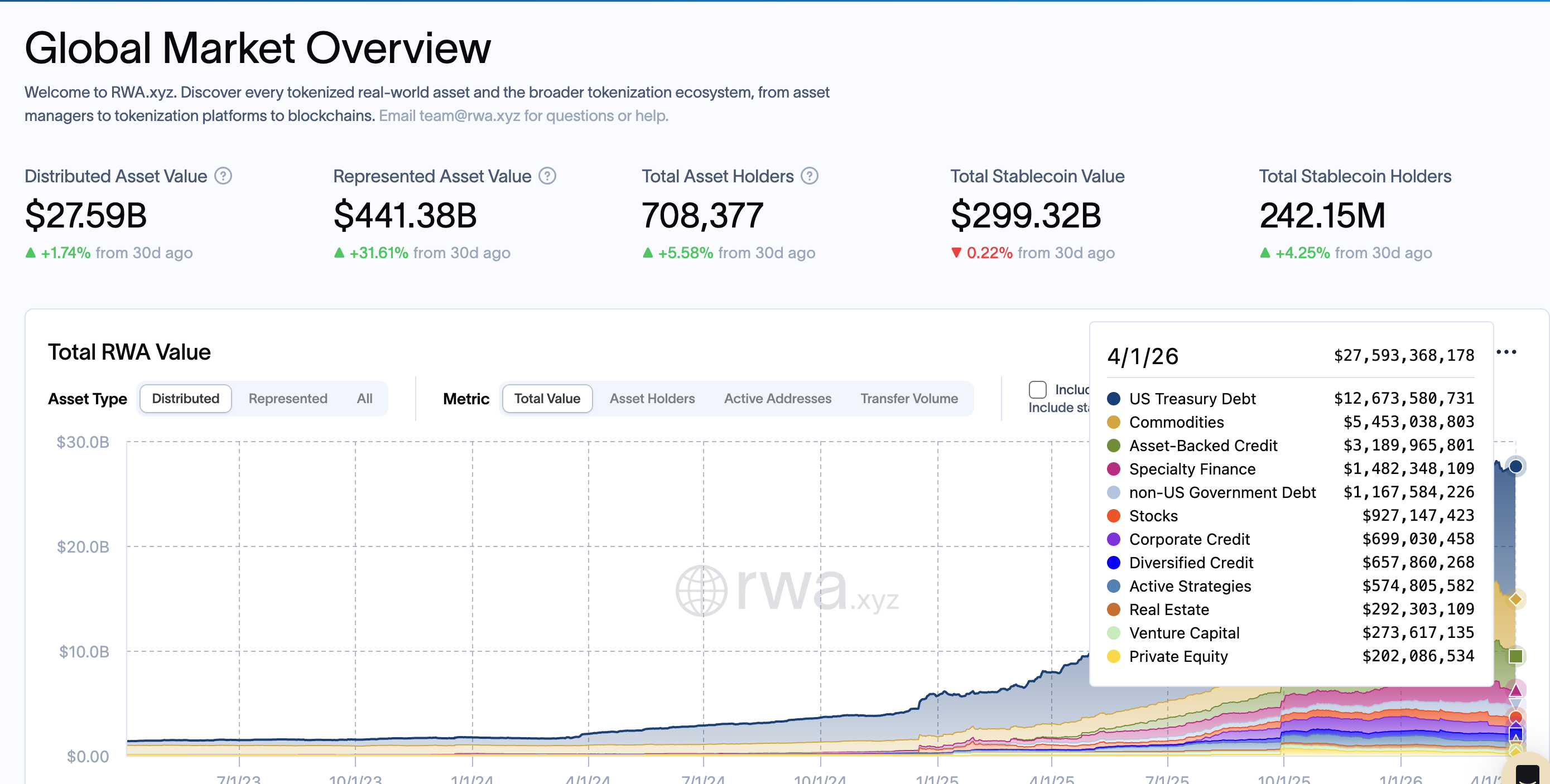
The broader market is scaling fast. RWA.xyz data as of April 2026 shows $12.67 billion in on-chain US Treasury debt, representing roughly 46% of the total $27.59 billion in tokenized real-world assets. That total grew 31.61% in just the last 30 days, with 708,377 asset holders across the ecosystem. Because everyone wants a piece of the tokenized pie.
This is Wall Street holding crypto infrastructure, not crypto assets. But it all depends on one thing: who has the keys.
The Custody Map: Where Centralization Meets Decentralization in a Hilarious Paradox
Knowing who owns Wall Street’s crypto is only half the story. The other half is who holds the keys. And let me tell you, it’s a mess.
Coinbase custodies over 80% of US Bitcoin and Ethereum ETF assets, a figure confirmed by CEO Brian Armstrong. Coinbase was the custodian for eight of the 11 spot Bitcoin ETF listings at launch. Only Fidelity self-custodies its own fund. VanEck selected Gemini. Because why spread the risk when you can concentrate it all in one place?
This concentration creates a single-cluster dependency. A cyber incident, service disruption, or governance failure at one custodian could affect multiple funds simultaneously, with knock-on effects for creations, redemptions, and trading liquidity. But hey, what’s the worst that could happen?
On the tokenized side, Bank of New York Mellon serves as BUIDL’s cash and securities custodian, while Anchorage Digital, BitGo, Copper, and Fireblocks support BUIDL subscribers. Because nothing says “decentralization” like a bunch of centralized custodians.
As of March 2026, discussions are emerging around multi-party computation custody and multi-custodian mandates to spread risk. But so far, it’s all talk and no action.
The custody map reveals a paradox at the heart of Wall Street’s crypto exposure: a decentralized asset class funneled through increasingly centralized infrastructure. And that infrastructure still leaves major holders invisible, specifically those with no filing obligation at all.
The Shadow Holders: Where Filings Go to Die and Secrets Thrive
13F filings only apply to US institutional managers with over $100 million in qualifying assets. Family offices, offshore entities, and sovereign vehicles operating through intermediaries are not subject to disclosure obligations. This creates a structural blind spot in Wall Street’s map of crypto ownership. Because nothing says “transparency” like a giant black hole of information.
On-chain data, however, reveals what filings cannot.
Cumberland DRW, one of Wall Street’s primary OTC desks, has processed a total of $123.58 billion in deposits and $97.71 billion in withdrawals across major exchanges since 2018. Filtering Cumberland’s outflows reveals where institutional capital actually goes. The top all-time outflow destinations include $17 billion to Binance, $14.53 billion to Coinbase Prime (likely for ETF creations), and $10.12 billion to Block Inc.

Scrolling further down the counterparty list confirms additional ETF and institutional plumbing. Fidelity’s FBTC ETF inflows appear at $7.28 billion across 171 transactions.
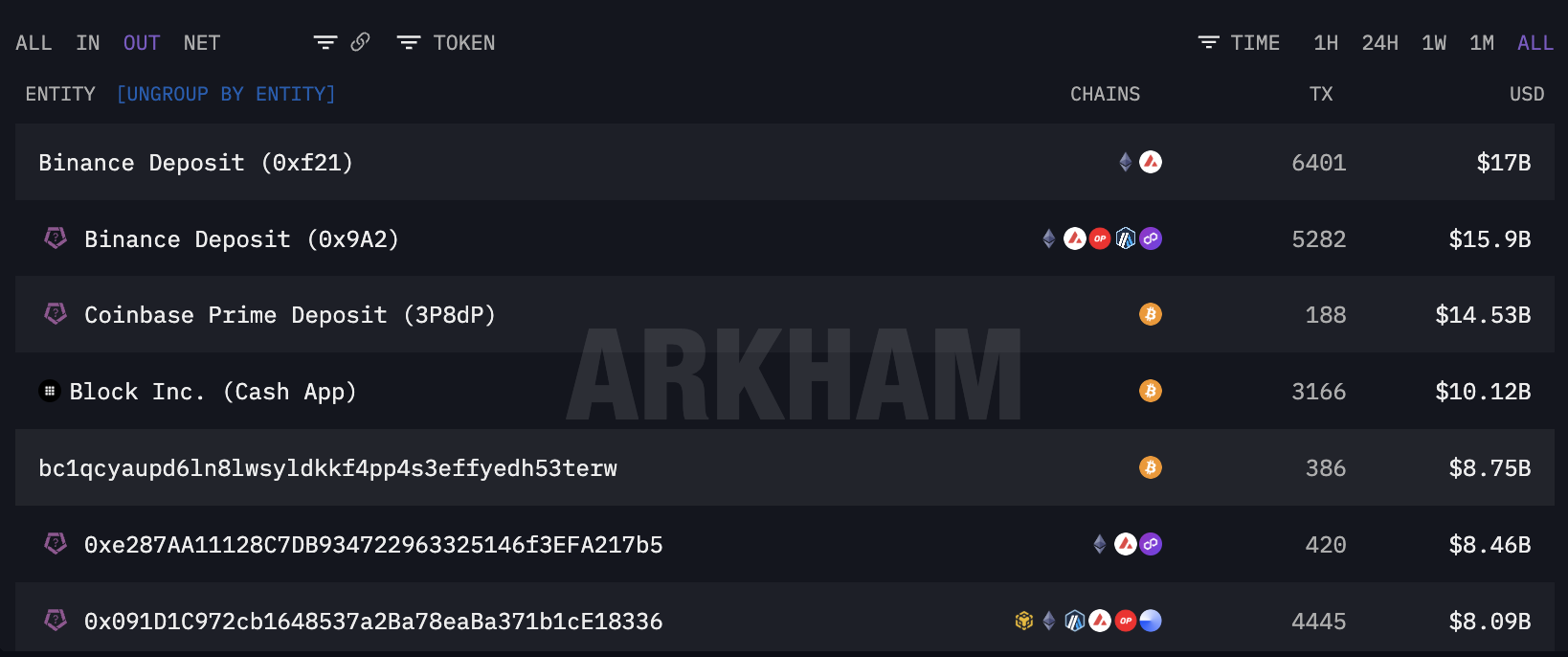
Alongside these labeled flows sit billions more directed to unlabeled wallets. The single largest unlabeled BTC recipient, wallet bc1qcyau..., received $8.75 billion across 386 transactions. It currently holds 593 BTC and uses Copper’s institutional prime brokerage for custody. That pattern-large OTC sourcing through a Wall Street trading firm paired with institutional-grade prime brokerage custody-is exactly the profile of a family office or sovereign vehicle operating through the same infrastructure as ETF issuers, just without the filing obligation.

The filings show part of the answer. The chain shows the rest. The gap between the two hides durable demand from shadow holders who bought through a drawdown and still hold through institutional custody, suggesting deeper structural support than any ETF tracker captures. That same gap also hides an untracked concentration that could crack it.
So, who’s really holding Wall Street’s crypto? A mix of institutions, corporations, and shadowy figures operating in the gaps between filings and on-chain data. And as for why? Well, that’s a question even the Auditors of Reality might struggle to answer.
Read More
- Gold Rate Forecast
- EUR TRY PREDICTION
- Brent Oil Forecast
- USD ZAR PREDICTION
- Silver Rate Forecast
- You’ll Never Guess What This Crypto ETF Claims To Do For Your Portfolio! 🤑
- Swiss Bank’s Bitcoin Blunder: Gold vs. Digital Fool’s Gold? 🤡
- XRP’s 233% Surge: Are the Whalers Happening Behind the Scenes?
- Bitcoin’s Bold $112K Move – Is It A Breakout Or A Breakdown? Find Out! 💥💸
- Bitfarms Ditches Bitcoin for AI: Stock Takes a Nosedive! 🚀💸
2026-04-05 00:41