According to Digital Ascension Group CEO Jake Claver, the ongoing debate about XRP’s market capitalization is focusing on the wrong issue. He believes the key question is whether the XRP network can handle large-scale payments from institutions without significantly increasing transaction costs. In a video released on March 26th, Claver explained that market cap isn’t a good indicator of how well a digital asset actually works, and XRP’s price would need to increase substantially to support the kind of high-volume settlements banks require.
Claver built his analysis around what he calls a “liquidity index,” a way to gauge how genuinely useful and stable a digital asset is, instead of simply looking at its price. This index considers six things: how easily the asset can be bought and sold in large quantities, consistent trading activity, the cost of transactions, how much of the asset is available, how quickly transactions settle, and how accessible it is. According to Claver, for an asset to function well as a payment method, it doesn’t need to increase dramatically in value—it just needs to be priced high enough to allow for substantial transactions.
According to Claver, the foundation of the future financial system needs to be built on stable assets, not just risky investments. For it to work worldwide, these assets must maintain a consistently reliable price.
Why XRP Could Need A Much Higher Price
As a crypto investor, I found Claver’s take on XRP really interesting. He’s not just looking at the total number of XRP out there, but how much is *actually* available to buy and sell. He argues that if more XRP gets locked up – maybe through staking or long-term holding – and demand goes up, the price will naturally increase because there’s less available to trade. Basically, he sees it as a limited supply with growing demand, and that shrinking float will play a bigger role in determining the price. It makes sense when you think about it in terms of XRP being used for payments – a fixed amount handling more transactions.
Claver then focused on market depth, explaining it’s the biggest hurdle for large institutions wanting to use XRP. He used the analogy of a pool of water – XRP needs enough liquidity to handle a large transaction without causing disruption. He explained that if a bank tried to transfer $100 million internationally with XRP, a small market couldn’t handle that volume smoothly, leading to price fluctuations.
From my research, price seems to be the key factor here. I’ve found that the amount of XRP needed to facilitate a large transaction depends heavily on its price. For example, if XRP is worth $1, a $100 million transfer would require 100 million tokens available in the liquidity pool. However, if the price jumps to $100 per XRP, the same $100 million transfer only needs a million tokens. Essentially, a higher price means you need fewer tokens to handle the same amount of value.
Claver explained that the issue of ‘slippage’ – the difference between expected and actual trade prices – is a major reason banks aren’t currently using cryptocurrency networks for large transactions. He pointed out that a $100 million XRP transaction could currently lose around 10%, or $10 million, due to slippage, whereas traditional stock markets handle similar transactions with less than 0.5% loss. To close this gap, he believes the amount of available cryptocurrency for trading would need to increase by 20 to 100 times. Since the amount of cryptocurrency available is limited, he says the price itself would have to adjust significantly to accommodate this increase in trading volume.
Claver believes the amount of XRP available on the market could decrease in the future. He explained that tokens are being held in places like ETFs, corporate holdings, and DeFi platforms, effectively removing them from general trading. He predicts that if demand increases while the available supply shrinks, the price won’t rise slowly and steadily – it will jump significantly when there are fewer and fewer sellers.
Besides cost, speed is a key benefit of XRP. According to Claver, XRP’s quick settlement times—just 3 to 5 seconds—allow money to be used more often compared to slower systems, helping traders manage their funds better. However, he pointed out that speed isn’t valuable on its own. If each trade had high fees—around 1% to 2%—the speed would simply mean losing money faster.
In my research, I’ve found that simply looking at market capitalization can be misleading. It assumes every token would be sold at the most recent price, which isn’t realistic. For a network like XRP, designed to handle large-scale international payments, the crucial test isn’t just price increases. It’s whether the network can handle big orders from institutions without significant losses. Essentially, higher XRP prices aren’t just about hype; they’re a necessary condition for the network to function as its supporters believe it can.
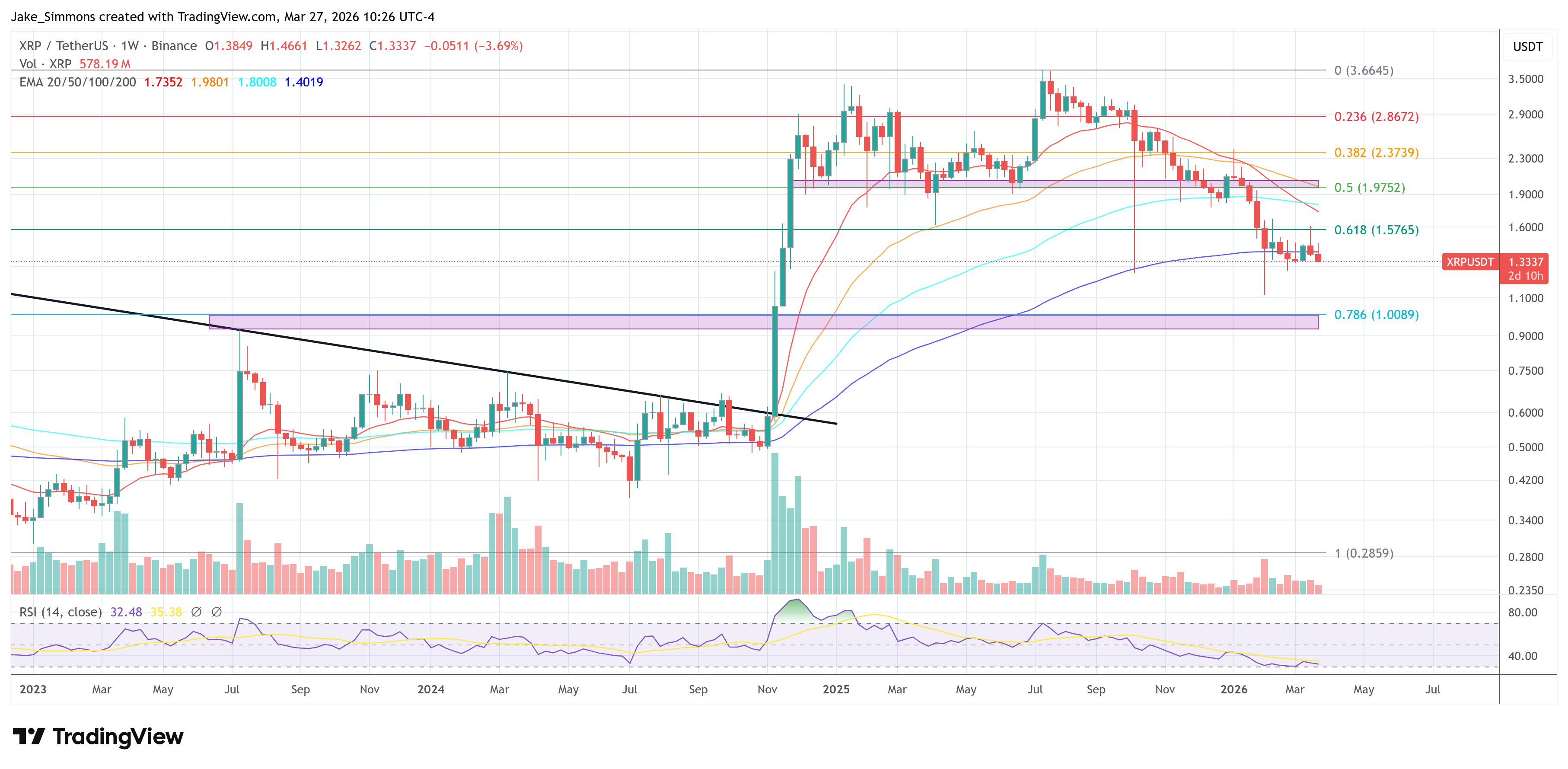
At press time, XRP traded at $1.3337.
Read More
- Pi Hotel Vietnam: First to Accept Pi Coin Payments in Real-World Transactions
- Brent Oil Forecast
- Why These 5 Meme Coins Could Crash or Cash Your Crypto Party in May 2025 🚀🐒
- EUR ILS PREDICTION
- USD VND PREDICTION
- EUR KRW PREDICTION
- XRP EUR PREDICTION. XRP cryptocurrency
- USD TRY PREDICTION
- Why Slovenia Wants to Take a Quarter of Your Crypto Cake (Starting 2026!)
- EUR AUD PREDICTION
2026-03-28 06:05