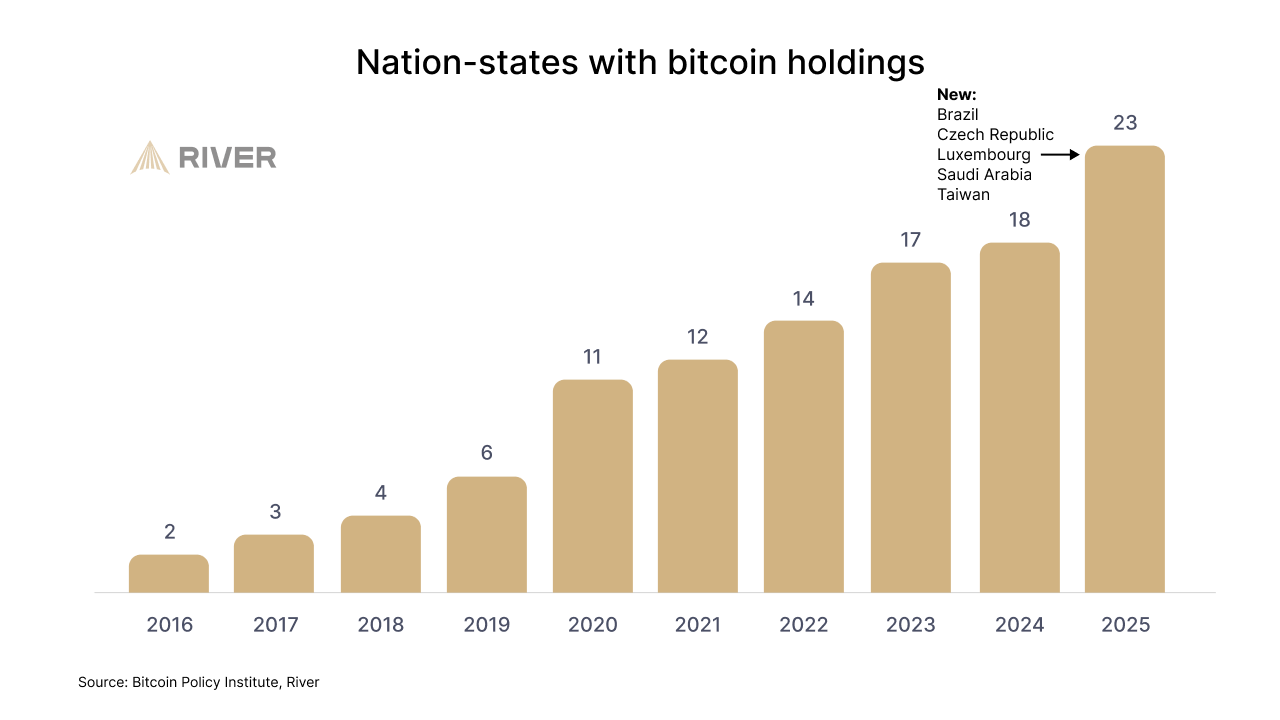
In a room where the glow of screens gnaws at the conscience, a new report from River arrives like a cold joke whispered by the universe: twenty-three nations now cradle bitcoin, turning a rumor into a stubborn asset on the sovereign ledger. Perhaps we should have known that even money loves a bargain with power.
River’s latest adoption report paints a stark picture: bitcoin (BTC) is no longer the gadget of hobbyists and scrappy founders. Governments are now part of the equation, with 23 nation-states estimated to own BTC through seizures, direct purchases, state-backed mining or sovereign wealth allocations.
The breakdown declares the United States sovereign in its holdings with 328,372 BTC, mostly amassed through seizures. The United Kingdom follows with 61,245 BTC, while the United Arab Emirates holds 30,382 BTC via sovereign wealth exposure and mining strategies. China, despite its domestic mining ban, is estimated to control 15,000 BTC through confiscations.
El Salvador remains the only country to have adopted bitcoin as legal tender and is listed with 7,514 BTC acquired through direct purchases. Bhutan appears with 5,884 BTC tied to state-backed mining, a small nation’s grand experiment in strategic exposure.
The report’s map of sovereign ownership spans North America, Europe, the Middle East, Asia, and parts of Africa and Latin America, reflecting what River describes as accelerating nation-state adoption. It is all rather melodramatic: coins on a ledger, power on a map, and a world that suddenly acts as if it understands economics.
Beyond sovereign holdings, River emphasizes that bitcoin’s infrastructure has grown more geographically dispersed. According to its hash rate distribution analysis, 34 countries now account for more than 0.1% of global hash rate, while 12 exceed 1%, suggesting mining concentration risk has eased compared with prior cycles. A comforting thought, if you enjoy your existential dread with a side of decimal points.
The ownership distribution data as of Dec. 31, 2025, indicates individuals still dominate with 14.01 million BTC, or 66.7% of supply. Funds and ETFs control 1.49 million BTC, businesses hold 1.45 million BTC, and governments account for 432,000 BTC, roughly 2.1% of the supply. A quiet reminder that the world’s great machine still hums to the tune of private hands, even when the stage is crowded with officials.
Institutional participation continues to broaden. River highlights allocations from hedge funds, asset managers, sovereign wealth funds, endowments, pension funds, and insurance firms, with billions in reported exposure across categories. The private sector becomes the chorus, while governments play a discreet if persistent bassline.
Merchant adoption is also expanding. The River report notes that North America led merchant growth in 2025, with 6,535 merchants accepting bitcoin and a year-over-year increase of 1,299. Europe maintains a slight lead in total merchants at 6,745. It’s oddly reassuring to see commerce drifting toward this peculiar digital coin, as if the marketplace itself finally decided to flirt with destiny.
On the payments front, Lightning Network activity saw significant growth. River estimates Lightning volume rose 300% in 2025, with exchanges increasingly integrating deposits and withdrawals, pushing average transaction sizes higher. A network that scales in a hurry-perhaps a way to hide the fear of a future where speed matters more than virtue.
Regulatory shifts appear to be moving in bitcoin’s favor in many jurisdictions. The report notes that 34 countries have approved bitcoin ETFs or ETPs, while several others legalized mining, clarified tax treatment, or allowed banks to custody bitcoin in recent years. Change arrives with the soft tread of inevitability, and a smile that is half doubt and half relief.
Taken together, the findings suggest bitcoin’s role in the global financial system is maturing. It is no longer solely a speculative vehicle; it is increasingly a strategic asset considered by institutions, businesses, and governments alike. The network born in the shadow of the 2008 financial crisis now finds itself on sovereign balance sheets in twenty-three countries, a chapter both audacious and unsettling in equal measure.
For a network born in the shadow of the 2008 financial crisis, landing on sovereign balance sheets in 23 countries marks a notable chapter in its evolution.
FAQ 🔎
- How many countries hold bitcoin, according to River? River estimates that 23 nation-states currently own bitcoin through various acquisition methods.
- Which country holds the most bitcoin? The United States leads with an estimated 328,372 BTC, largely from asset seizures.
- How do governments acquire bitcoin? Governments obtain bitcoin through seizures, direct purchases, state-backed mining and sovereign wealth allocations.
- What share of bitcoin supply do governments control? Governments collectively hold about 432,000 BTC, representing roughly 2.1% of total supply.
Read More
- Silver Rate Forecast
- Brent Oil Forecast
- Gold Rate Forecast
- ETH PREDICTION. ETH cryptocurrency
- USD TRY PREDICTION
- USD MXN PREDICTION
- EUR PLN PREDICTION
- EUR INR PREDICTION
- DOGE AUD PREDICTION. DOGE cryptocurrency
- EFCC Chases “Crypto Cowboy” Through Lagos: Thousands Robbed, Detectives Confused 🤠💰
2026-02-26 02:27