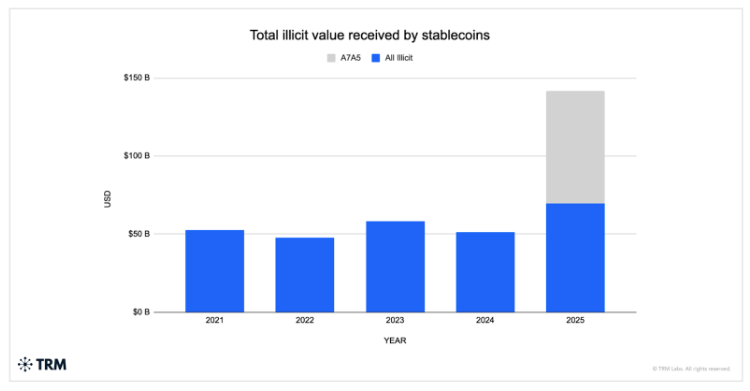
In the year 2025, a sum of $141 billion in stablecoins, those digital darlings of predictability, found its way into the hands of ne’er-do-wells and miscreants. One might say the coins, so stable in value, proved equally stable in their appeal to those who prefer their transactions as shadowy as a Moscow winter’s night. Networks, few in number but vast in ambition, favored these tokens for their swiftness and reliability-qualities, it seems, that are not exclusive to honest trade.
It is not that every stablecoin has taken to a life of crime, mind you. No, the blame lies with concentrated channels, where these tokens serve a specific, if unsavory, purpose: moving value with the stealth of a cat burglar, far from the prying eyes of traditional banking. A modern convenience, indeed, for those who prefer their finances as discreet as a whispered secret.
Sanctions? More Like Suggestions for These Networks
According to TRM Labs, a staggering 86% of illicit crypto transfers last year were linked to sanctions. Of this, $72 billion traced back to a ruble-pegged token, no doubt a favorite among Russian networks. These networks, far from isolated, have tentacles reaching to China, Iran, North Korea, and Venezuela. Stablecoins, it appears, are the diplomatic couriers of the sanctioned world, bridging gaps with the efficiency of a well-oiled machine.
The mechanics are simple, almost banal: when predictability is paramount, and volatility a risk one cannot afford, stablecoins step in. A reliable tool, one might say, for those whose business cannot tolerate the whims of the market.
Escrow for the Unsavory: Stablecoins in the Underbelly
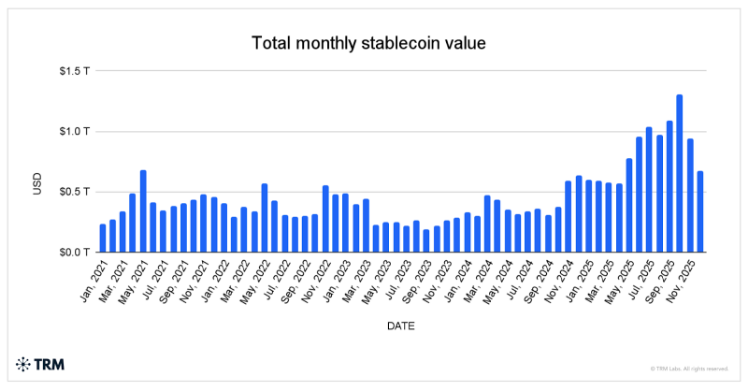
Certain marketplaces, operating in the shadows, saw volumes surge-almost entirely in stablecoins. Escrow and guarantee sites, acting as middlemen for high-value transfers, moved tens of billions with the finesse of a seasoned con artist. These venues, almost exclusively stablecoin-denominated, raise more red flags than a Soviet parade. Chainalysis and others note a sharp increase in flows to networks tied to human trafficking and escort services, where stablecoins are the payment of choice. Certainty and liquidity, it seems, trump moral qualms.
Crime, Like Art, Has Its Preferred Mediums
Scams, ransomware, and thefts often begin in Bitcoin or Ether, only to shift into stablecoins later-a laundering tactic as predictable as a Chekhovian tragedy. Attackers, it seems, prefer an asset that holds its value while they move it through fewer hands. A practical choice, one might say, for those who value efficiency in their misdeeds.

Market Cap: A Tale of Dominance
Meanwhile, the global stablecoin market has ballooned into a multi-hundred-billion-dollar behemoth, with a total market capitalization of roughly $270 billion in early 2026. According to Stablecoin.com, the combined value of major stablecoins consistently hovers in the mid-hundreds of billions, with fiat-backed coins leading the charge.
Two issuers dominate this landscape with the inevitability of a Chekhovian climax. Tether’s USDT leads by a wide margin, its market cap often reported at $180 billion or more, representing over two-thirds of the total stablecoin market. Circle’s USD Coin (USDC) follows in second place, with a market cap often above $70 billion. Together, they hold over 90% of stablecoin capitalization-a duopoly as unshakable as a Russian winter.
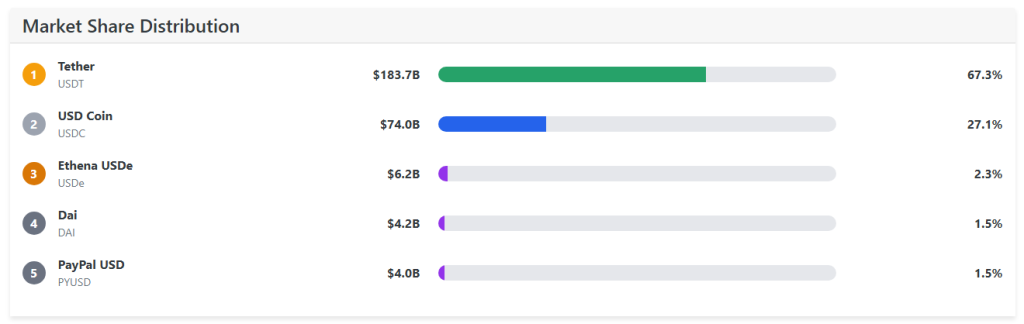
Smaller stablecoins like Ethena USDe, DAI, and PayPal USD make up a much smaller portion of the market, signaling a diversification that is as slow as a Chekhovian character’s realization of their own folly. Yet, they persist, a testament to the enduring human desire for variety, even in the most stable of markets.
Read More
- Silver Rate Forecast
- Gold Rate Forecast
- Brent Oil Forecast
- Polymarket’s 3.14% Pie: A Slice of Genius or Just Crumbs?
- Coinbase’s OCC Nod: Not a Bank, Just A Trust-Big Moves Ahead!
- XRP’s Institutional Comeuppance: Finally, a Seat at the Table
- Claude’s ID Fiasco: Anthropic’s Latest Farce in AI Theatre
- Bitcoin’s Wild Ride: War, Oil, and Triangles, Oh My!
- Bitcoin at 75k: The Trigger That Could Unleash a Rally
- ONDO PREDICTION. ONDO cryptocurrency
2026-02-20 18:11